

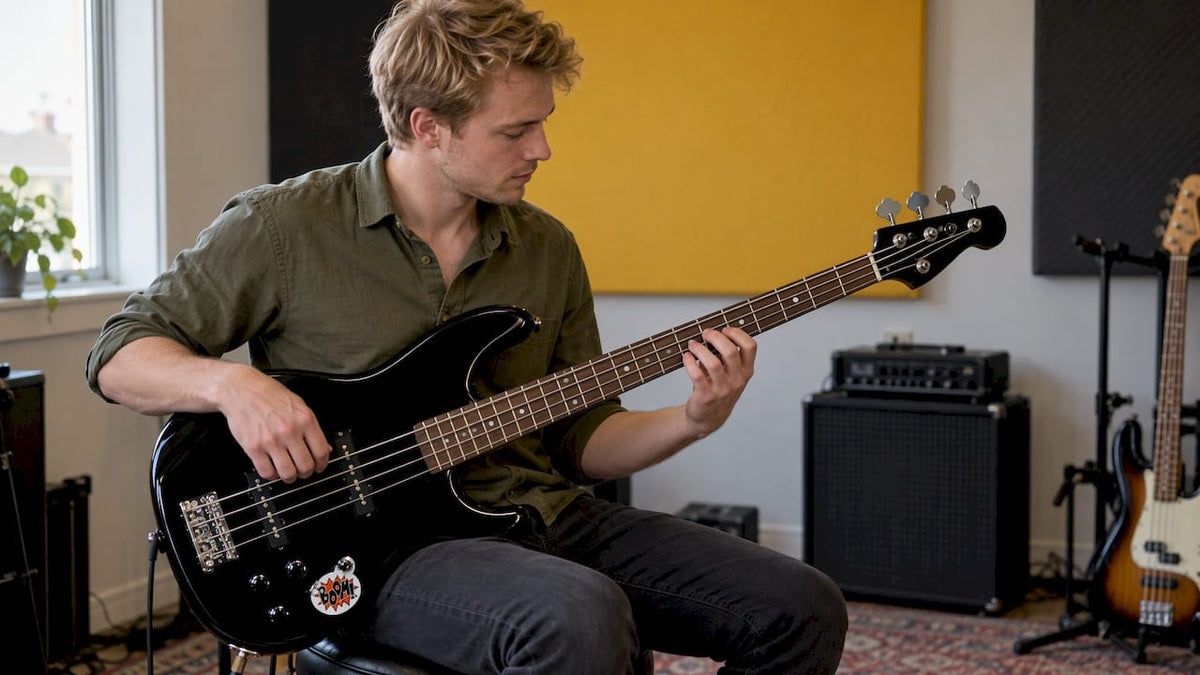
A bass scale is a set of notes played in order up and down the neck, starting and finishing on the same note, the root. Learn five of them (major, natural minor, major pentatonic, minor pentatonic and blues) as shapes you can move to any root, and you have most of what rock, pop, funk and blues basslines draw on. A well-set-up bass makes that learning far easier, because shapes only stick when every note rings cleanly. That is why we set up and inspect every instrument at our Huntingdon shop before it goes out.
This guide gives you the theory in plain words, the fingerings, the notes of A major, a practice routine and a short list of what to learn next.
Table of Contents
- What a bass scale actually is
- The major scale: your reference point
- Natural minor: the same notes, a different home
- Pentatonic and blues: the scales you will use most
- Using scales in real basslines
- A practice routine that builds fluency
- Intervals first, shapes second
- Where to go next: modes and other scales
- Get a bass that lets the shapes ring
- Our view: scales are for your ears and hands
- FAQ
- Sources
What a bass scale actually is
A scale is a sequence of notes with a fixed pattern of gaps between them. The gap between two neighbouring frets is a semitone (a half step). Two frets is a tone (a whole step). A major scale uses seven of the twelve notes in Western music, and the root is the first note, with the degrees numbered 1 to 7 (Mastertemps).
The major scale formula is tone, tone, semitone, tone, tone, tone, semitone. Start on any note, follow that recipe and you get a major scale. Start on G and you get G, A, B, C, D, E, F♯, G. Every scale works this way: a recipe of gaps, not a fixed set of fret numbers. That is why a shape you learn once works in every key.
On tab, the four lines are your strings (the lowest line is the lowest string) and the numbers are frets. Standard four-string bass is tuned E, A, D, G from lowest to highest, each string a perfect fourth above the last. That tuning is what makes the shapes repeat: a pattern played on the E and A strings looks identical one string over, on the A and D strings, with the same fingers.
If you want a gentler introduction to why scales matter before the detail, our own guide covers why scales matter for bass players.
The major scale: your reference point
The major scale is the yardstick. Other scales are described by how they differ from it, so learn it first. BassBuzz’s beginner lesson makes the point that learning a scale means learning its form, the physical shape under your hand, and its fingering well enough to play it from any starting note (BassBuzz).
The one-octave fingering
Bass frets are wide, so the usual approach is a four-fret hand position with one finger per fret. StudyBass teaches a one-octave major scale this way: second finger on the root, no hand shift, playing root, 2, 3, 4, 5, 6, 7 and the octave, then back down in reverse. Put the low root on the E or A string and the same pattern gives you every major scale (StudyBass).
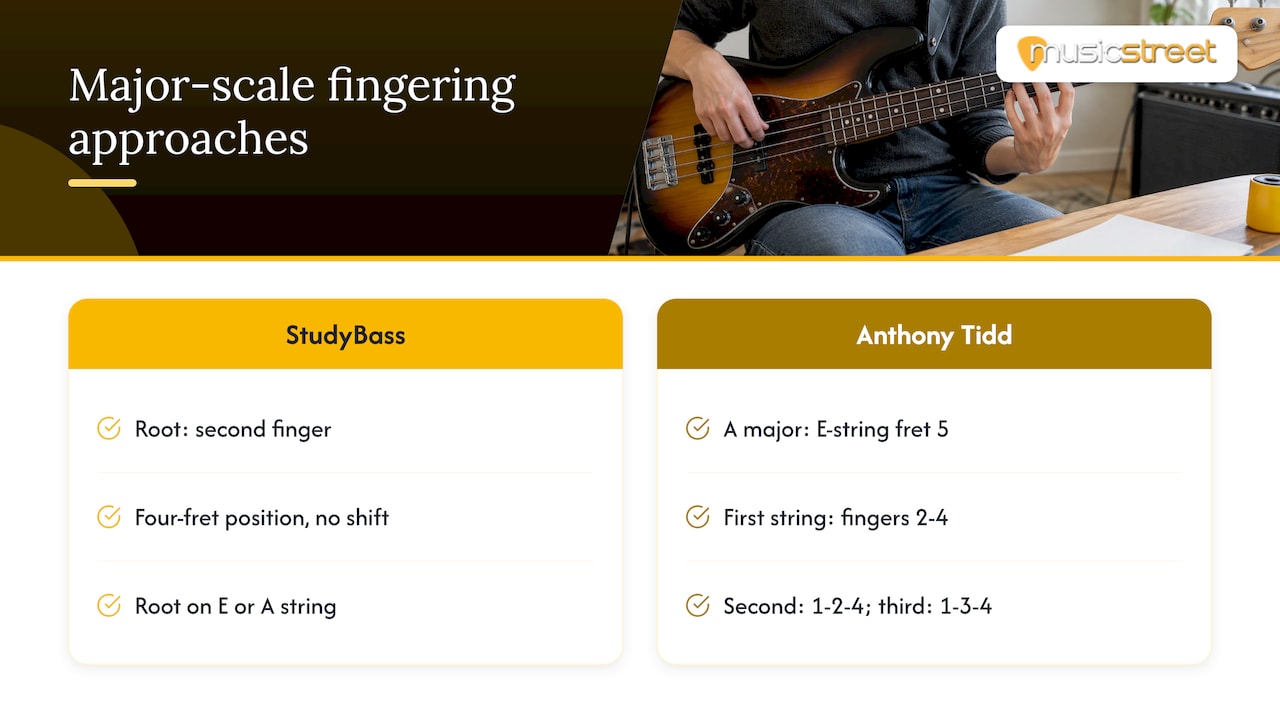
Premier Guitar’s Anthony Tidd gives an alternative closed-position fingering for A major starting on the fifth fret of the E string: 2-4 on the first string, 1-2-4 on the second, 1-3-4 on the third. His point is that memorising a few three-string shapes lets you produce a major or minor scale in any key, anywhere on the neck (Premier Guitar).
Where it goes wrong: players shift their hand for every note instead of holding the position, and the fingers then land late. Keep the hand still and let each finger own a fret. If your fourth finger struggles to reach, practise slowly and in short sessions rather than forcing the stretch.
Our step-by-step page on mastering the major scale on bass guitar walks through the shape in more detail.
The notes of A major on bass
A common question is which notes make up the A major scale. They are A, B, C♯, D, E, F♯ and G♯, then A again an octave higher (guitarscale.org). On a four-string bass the lowest A is the fifth fret of the E string, so the one-octave pattern starts there and climbs:
| Degree | Note | String and fret |
|---|---|---|
| 1 (root) | A | E string, 5th fret |
| 2 | B | E string, 7th fret |
| 3 | C♯ | E string, 9th fret |
| 4 | D | A string, 5th fret |
| 5 | E | A string, 7th fret |
| 6 | F♯ | A string, 9th fret |
| 7 | G♯ | D string, 6th fret |
| 8 (octave) | A | D string, 7th fret |
The A, D and E open strings all belong to the key, which is part of why A is such a friendly key for a first song.
Natural minor: the same notes, a different home
Natural minor is built on a different recipe, but there is a shortcut: a natural minor scale is the major scale started from its sixth degree. Talking Bass uses this to show that C natural minor (C, D, E♭, F, G, A♭, B♭) shares its notes with E♭ major (Talking Bass).
Tidd’s fingering for A minor from the first finger is 1-3-4 on the first string, 1-3-4 on the second and 1-3 on the third (Premier Guitar). Compare it with the major shape and you will feel the difference: the third note sits a fret lower, which is what gives minor its darker colour.
We also cover this scale in getting started with the natural minor scale.
Pentatonic and blues: the scales you will use most
Pentatonic means five notes. Dropping two notes from a seven-note scale removes the ones most likely to clash, which is why these shapes are so usable for grooves.
- Major pentatonic: the major scale without its 4th and 7th. In C that gives C, D, E, G, A (Talking Bass).
- Minor pentatonic: the natural minor scale without its 2nd and 6th, so C, E♭, F, G, B♭ (Talking Bass).
- Blues scale: the minor pentatonic with one extra note, the flattened fifth, used as a passing note between the fourth and fifth degrees. That gives the formula 1, ♭3, 4, ♭5, 5, ♭7 (Skoove).
BassBuzz calls the minor pentatonic the go-to scale for bluesy, funky, rock and metal playing, and compares it to a Swiss army knife (BassBuzz). In practice, treat the blues note as a step you pass through quickly on a weak beat rather than a note to rest on.
The box shapes are easier to see on a diagram than to describe, and our pentatonic and blues box patterns are laid out for five-string players too. For a simpler start, see learning the simple pentatonic scale shapes.
Using scales in real basslines
Scales are not a performance in themselves. Bassists use them as a map of safe notes. The Berklee Practice Method for bass makes the point that strong lines come from combining the tune’s chords, matching scales and a rhythmic groove, and that simple lines of roots, or roots and fifths, can be very effective (Berklee Practice Method).
So the working order is:
- On the first beat of a new chord, play that chord’s root.
- Fill the space with the chord’s fifth and octave, which come from the scale.
- Add scale notes or a quick chromatic passing note on weak beats to connect one chord to the next.
The root, fifth and octave idea is the classic starting point. Lindemere recommends it for building lines and jamming, and suggests listening to “All Along the Watchtower”, “Linus and Lucy” and “Rio” to hear it (Infinite Bass).
A practice routine that builds fluency
Beginners tend to rush. Johnny Cox, a UK bass teacher, advises that your first tempo should feel slow and your last should feel fast. His point is that a metronome keeps you in time and also stops you playing faster than you can control (Johnny Cox Music).
Here is a routine built from the sources above. Allow about 15 to 20 minutes.
- Major scale, one octave (4 minutes). Use the one-finger-per-fret shape, ascending and descending, one note per click with a metronome. Start slowly.
- Minor scale or triad (4 minutes). Play A minor, then the triad of root, minor third, fifth and octave. No Treble’s Ryan Madora recommends exactly this pairing, plus steady eighth notes with alternating index and middle fingers, for beginners (No Treble).
- The ABC exercise (4 minutes). Take any three adjacent notes of the scale and play that fragment from every position, in both directions. BassBuzz recommends it as a way to turn the shape into something you can hear and feel (BassBuzz).
- Move the shape (4 minutes). Shift the same pattern up a fret and repeat. This is how one shape becomes twelve keys.
- Play it as music (remaining time). Turn a fragment into a groove with a rhythm you like.
Graded, short drills are how singers build control too, as these types of vocal exercises show, and the same principle holds on bass: start easy, add speed gradually and stop before your hand tires.
If you want to go deeper on structure, our page on practice routines that build real fluency is aimed at five-string players but the habits carry over.
Intervals first, shapes second
A shape tells you where to put your fingers. An interval tells you why. Pete Lindemere argues that understanding intervals is what unlocks chord and scale structure (Infinite Bass). If you know that a major third is four semitones above the root, you can find it on any string without a chart.
The tuning helps again here. Because adjacent strings are a fourth apart, a note that needs a stretch on one string can often be played on the next string up, five frets lower. Use that when a shape feels awkward and you will rarely need to shift your hand.
Five-string players get extra range from the low B, and the maps change with it, as we explain in why intervals matter more than shapes on a 5-string and in how BEADG and EADGC change your neck maps.
Where to go next: modes and other scales
Once the five core scales are comfortable, three modes add useful colour:
- Dorian (1, 2, ♭3, 4, 5, 6, ♭7) suits funk and minor chords. Its major sixth gives the sound.
- Mixolydian (1, 2, 3, 4, 5, 6, ♭7) suits dominant seventh chords, with the ♭7 as the target note.
- Lydian (1, 2, 3, ♯4, 5, 6, 7) suits major chords where you want a brighter sound.
These uses are laid out in Miles Plays Bass’s guide to jazz scales (Play Electric Bass). Melodic minor (the major scale with its third lowered a fret) and harmonic minor (natural minor with its seventh raised a fret) come after that, for jazz, metal and world music styles.
For a full reference of scales in notation, tab and diagrams, Mark J Smith’s Scale Reference Manual for Bass Guitar writes most scales from a C root so they are easy to transpose.
If you want printable charts of your own, see how to find and build printable scale charts, and for the formulas on five strings see major and minor scale patterns on a 5-string.
Get a bass that lets the shapes ring
Scale practice repeats the same notes hundreds of times, so you hear every fret buzz and every dead note. A bass that has been properly set up and inspected makes the difference between a pattern that feels logical and one that feels like a fight. Our bass guitar range includes new and pre-owned instruments, and you can try them in store in Huntingdon, Cambridgeshire, or order online with free UK delivery above a minimum order value.
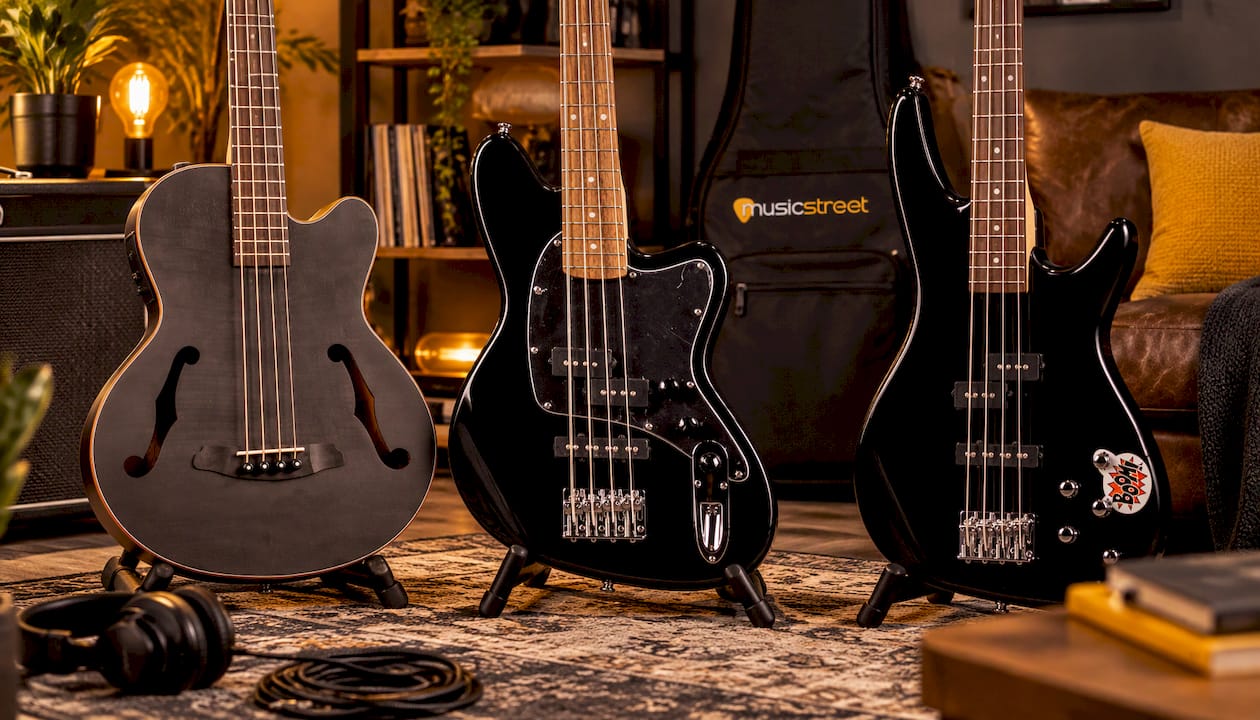
If you are starting out, the Ibanez GSR200B is one to look at, and the Ibanez TMB30-BK Talman short-scale bass and the Aria FEB F2M medium-scale acoustic bass are listed too. Fresh strings make scale work sound clearer, and we offer an in-store restring service alongside guitar setups, servicing and repairs.
Our view: scales are for your ears and hands
We sell basses to people at every stage, and the ones who progress fastest treat scales as a way to learn the neck, not as a chore. Learn one shape, move it, and say the interval out loud as you play it.
The second thing is the instrument. A bass that is set up and inspected before it reaches you lets you hear your own mistakes rather than the instrument’s. That is why every instrument we sell gets an expert setup and inspection, and why we back it with after-sale support and an insurance-supported warranty.
Come and try a few basses in the shop and play the same scale on each. You will hear and feel which one makes the pattern easy.
Music
FAQ
What is the three-fret rule on bass?
It is a way of describing the four-fret hand position: each finger takes one fret, so every note in a position sits on the starting fret, one below it or up to three above it. Keeping to that box means you shift less and play more evenly.
Is bass harder than guitar?
Not for scales. You play one note at a time, and the shapes are the same ones guitarists learn. The frets are wider, so the hand position needs a little more stretch at first, but one finger per fret and slow practice solve that.
Which scale should a beginner learn first?
The major scale, because other scales are described by how they differ from it. Follow it with the minor pentatonic, which BassBuzz describes as the go-to scale for rock, funk and blues grooves (BassBuzz).
How long should I practise scales each day?
Short and regular beats long and rare. About 15 to 20 minutes with a metronome, starting slowly, is enough to build the shapes into your hands. Stop when your tempo outpaces your accuracy.
Sources
- Mastertemps: Bass Guitar Major Scales
- BassBuzz: Bass Scales For Beginners
- StudyBass: One-Octave Major Scale
- Premier Guitar: Master Electric Bass by Mastering Positions
- guitarscale.org: A Major bass guitar scale
- Talking Bass: 5 Easy Bass Scales for Beginners
- Skoove: boogie woogie style and the blues scale
- Berklee Practice Method: Bass
- Infinite Bass: Bass Scales, the Complete Map
- Johnny Cox Music: bass practice exercises
- No Treble: 3 Things Every Beginner Bass Player Should Practice
- Play Electric Bass: 7 Best Jazz Bass Scales
- Scale Reference Manual for Bass Guitar

Share:
What Does an Echo Do? Meaning, Sound and Guitar Effect