


Place the capo just behind the fret wire and tighten only until every string rings clearly. Pluck each open string one at a time and listen for buzz or a dull thud. Then strum a simple chord: if any string sounds sharp, loosen the capo, re-seat it and re-tune.
Table of Contents
- Where exactly does the capo go on the neck?
- How tight should the capo be, and how do you check tuning?
- Which capo design suits your guitar?
- How does a capo change the key of a song?
- How do you adjust your fingering with a capo in place?
- What do you do when the capo buzzes or goes sharp?
- Which three drills build clean capo changes?
- What we see in the workshop when capos cause trouble
- Pick up a Kyser partial capo and book a setup in store
- FAQ
- Sources
Where exactly does the capo go on the neck?
Look at the fret you want to use. The metal fret wire sits at its right-hand edge (as you view the neck, headstock on the left). The capo bar should rest in the gap just behind that wire, as close as possible without touching it. Our own capo guide explains why: on top of the fret, the capo deadens the string, and mid-fret it needs far too much pressure, which pulls notes out of tune.
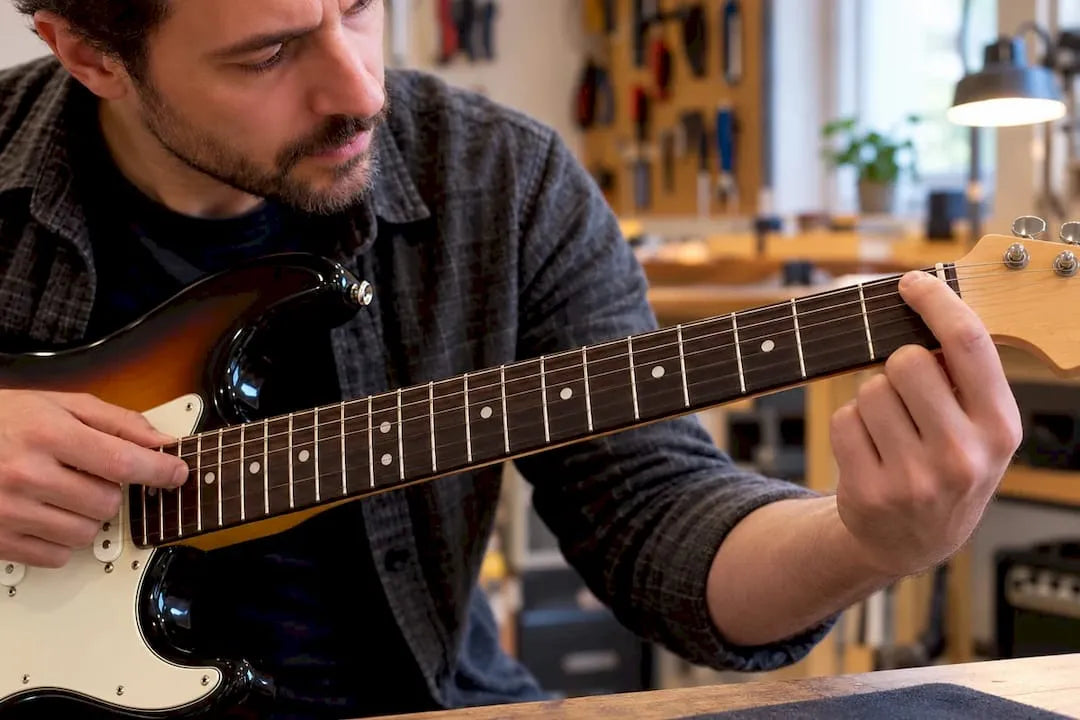
On an acoustic neck the frets are easy to see, and the bar usually sits flat against the fingerboard. On an electric the neck is often slimmer and the radius flatter, so check that the bar contacts every string evenly. Here is the routine we teach at the counter:
- Open the capo and hold it with the clamp end resting against the back of the neck.
- Set the bar just behind your chosen fret, parallel to the wire, not tilted.
- Rest your picking-hand palm across the strings and give them a light, firm press, a small “chop”, while you close the capo with your fret hand. This takes up string slack and evens out the tension.
- Pluck every string in turn to check it rings.
- Leave a small deliberate gap between the bar and the wire if your index finger feels cramped when forming open chords.
Pro Tip: Fit the capo while the guitar is already in tune, then check the tuning again afterwards. Fitting it first and tuning second hides the very problem you are trying to spot.
How tight should the capo be, and how do you check tuning?
The golden rule is minimum pressure for a clear ring on every string. Squeezing harder pulls the strings sharp, and the sharpest offenders are usually the thinner ones. As FreshKit’s capo guide puts it, a capo clamps all the strings and becomes a movable nut, and placing it just behind the fret needs the least pressure. Screw or yoke capos let you fine-tune the tension, while trigger capos give you less control, so their placement needs more care.
Our own rule of thumb: getting the fit right can make capo use easier, as our capo guide explains.
Run these four checks every time you fit a capo:
- Pluck each open string one by one and listen for buzz, rattle or a choked tone.
- Strum a simple open chord such as G or C and listen for anything that sounds off.
- Play a natural harmonic near the capo and compare it with the fretted note at the same spot. If they disagree, the capo is pulling the strings out of tune.
- Re-tune any string that went sharp, then repeat the strum test.
If you want a refresher on tuning checks, our guide to tuning to open G walks through similar verification steps.
Which capo design suits your guitar?
Capos come in a few main designs, and each handles tension differently.
- Spring or trigger capos: quick to move between frets with one hand, but tension is fixed, so placement matters more.
- Screw or yoke capos: you set the tension yourself, which suits beginners who want to find the lightest workable grip.
- Partial capos: cover only some of the strings, which opens up alternate tunings and drone effects without retuning.
- Wrap-style capos: a strap with a pad that wraps around the neck, handy on unusual neck shapes.
Before buying, check three things: the neck curvature (a flat electric radius and a rounder acoustic neck want different bar shapes), the width at the nut, and the clearance around your headstock. A capo that sits flat on your neck needs less pressure to seal every string.
For beginners, look for ease of use, fine control over tension and minimal effect on tuning. We carry the Kyser Capo Partial Acoustic Black, the Kyser Capo Partial Acoustic Silver and the Kyser Capo Partial Acoustic Gold as partial options, and all three suit acoustic players who want to try selective capoing. If you would like to compare accessories, browse our guitar accessories. Nylon strings need a lighter touch than steel, so a capo with adjustable tension is the safer choice for a classical neck.

How does a capo change the key of a song?
A capo acts as a movable nut. Place it at fret x and every string rises by x semitones, so every chord you play sounds x semitones higher than its shape suggests. Gospel Music’s capo lesson sets out the same principle and shows how chord shapes transpose accordingly.
So a capo never lowers the key; it only raises it. To find the right position for a singer, count the semitones between the original key and the key you want, then place the capo at that fret and play the original chord shapes.
- Capo on the 3rd fret: an open C shape sounds as E flat, a G shape as B flat, and an Am shape as Cm.
- Capo on the 5th fret: an open G shape sounds as C, a C shape as F, and an Em shape as Am.
- Counting method: move up one fret per semitone: C, C sharp, D, D sharp, E and so on.
If counting feels clumsy, an interactive transposition wheel lines up the original key with the key you want, and the rest of the chords follow. The Ukulele Club Liverpool transposing guide describes a similar method: establish the song’s key, write out the root-chord positions, then place the capo the required number of semitones.
Pro Tip: Write the capo fret at the top of every chord sheet. When you come back to a song a week later you will not have to work it out again.
How do you adjust your fingering with a capo in place?
A capo shortens the playable scale length, so the frets sit closer together as you move up. Your reach changes: stretches that felt easy near the nut get tighter, but your fretting hand also needs to travel less. Keep your thumb relaxed behind the neck and curve your fingers so they press down just behind each fret.
- Stay with open shapes when the song is built from G, C, D, Em and Am. These are the shapes the capo was made for, and they ring fuller than barre chords.
- Switch to moveable shapes when you want a particular voicing higher up the neck, or when the capo’s position leaves you short of room for your index finger.
- Watch the clearance between your index finger and the capo bar. If your open chords feel cramped, shift the capo slightly further from the wire or take a different shape.
- Use a partial capo to hold down a few strings and leave the rest open, which gives you ringing drone notes with simple fingering.
Our guide on reading guitar tablature helps when you need to convert a chord diagram to the new fret positions, since the numbers shift relative to the capo.
What do you do when the capo buzzes or goes sharp?
Most capo faults come down to placement or pressure. Work through these in order:
- Notes sound sharp: loosen the capo slightly, re-seat it just behind the fret, and retune.
- A string buzzes or sounds muted: the bar may be sitting on the fret wire or pressing unevenly. Lift it, reposition it and test each string again.
- One side of the neck feels loose: adjust the bar so it sits parallel to the fret, and on a screw capo, even out the tension from both ends.
- Tuning drifts every time you move the capo: check your string age first, because tired strings stretch and slip. Old strings are the commonest cause we see.
- Problems persist across several guitars: the cause is likely neck relief, nut slots or intonation, which are issues a professional setup will fix.
If you need fresh strings, our guitar strings range covers acoustic, electric and classical sets.
Which three drills build clean capo changes?
Short, repeated drills build speed and accuracy better than long sessions. Our beginner chord practice strategies pair well with the drills below.
- Seat and sound: fit the capo, pluck each open string slowly, then strum one chord. Repeat five times, moving the capo off and on each round.
- Timed fret changes: swap the capo between the 2nd and 4th frets, checking the ring on every string. Aim for smooth, clean changes before you try to go faster.
- Match the singer: hum or sing a line, then move the capo until a simple chord shape fits your voice. This trains your ear and your fretting hand together.
If you are still building your basics, our beginner guitar lessons guide covers the shapes these drills rely on.
What we see in the workshop when capos cause trouble
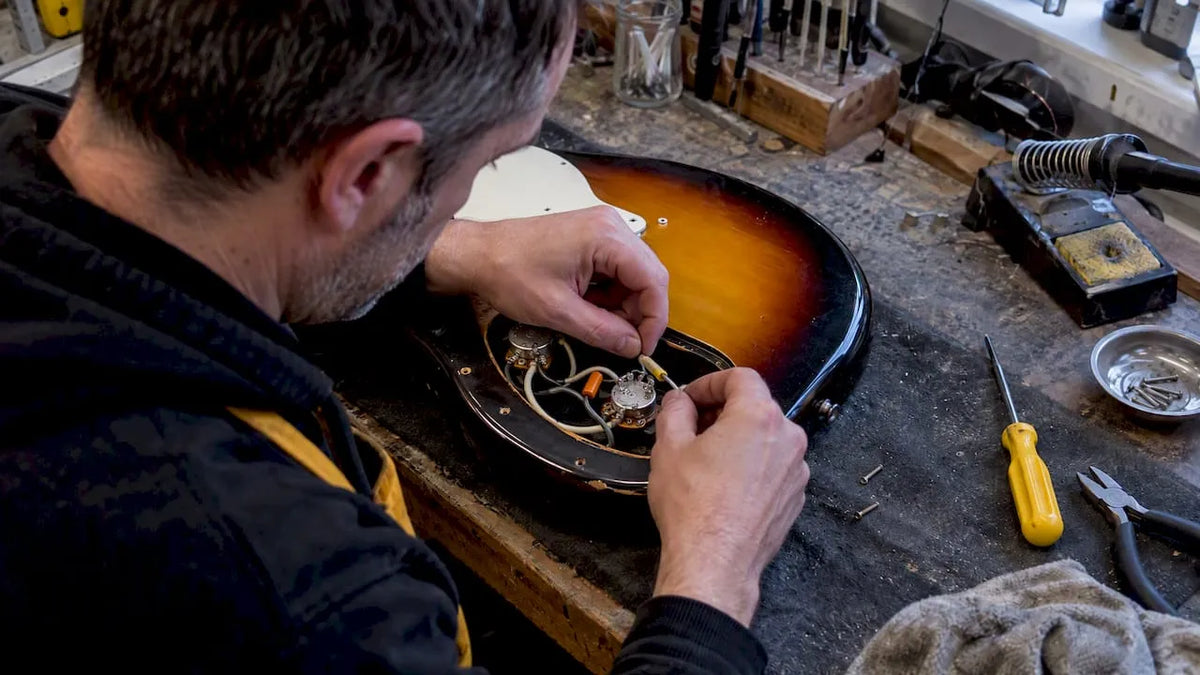
Most capo complaints that reach our bench turn out not to be about the capo at all. We regularly trace them to intonation that has drifted, a nut slot cut a touch high, or a bridge that needs a check. A capo simply exposes those faults because it asks every string to be in tune at a new position. If your tuning problems stay put after you have sorted the placement and pressure, book a setup rather than fighting the capo. We offer restringing and setups in store, and a fresh pair of eyes on the guitar is often all it takes.
— Music
Pick up a Kyser partial capo and book a setup in store
If you want a capo that is straightforward to use and kind to your tuning, start with the Kyser Capo Partial Acoustic Black, the Silver or the Gold. They make selective capoing simple for acoustic players who are still learning the ropes.

If your guitar still goes sharp or buzzes with a capo on, our in-store restring and setup services can help investigate the cause. Browse our guitar strings or visit our shop to book your guitar in.
FAQ
Does a capo change the key up or down?
A capo raises the key. Each fret you move it up lifts every string by one semitone, so chord shapes sound higher than they look. To go lower you would need to retune the guitar, not use a capo.
What is the 3 fret rule on guitar?
There is no single official “3 fret rule”, and definitions vary between teachers. A common practical version is that a capo on the 3rd fret turns familiar open shapes into chords three semitones higher, which is a handy way to move a song up for a singer.
Is a capo for beginners?
Yes. A capo lets you play songs in higher keys using chord shapes you already know, so you do not need to master difficult barre chords first. Our capo guide notes that it opens up access to songs in higher keys.
What does a capo on the 3rd fret do?
It acts as a new nut at fret three, raising every string by three semitones. An open G shape then sounds as B flat, and an open C shape as E flat, as Gospel Music’s capo lesson explains.





Share:
Amp Types for Beginners: 3 Picks Matched to Real Use Cases