


Grab a bass-capable tuner (a clip-on or a tuner app both work fine), and tune your strings in this order: low E, then A, then D, then G. Always tune up to the note rather than down, since coming from slightly flat keeps tension on the string and stops it slipping back. Once you’ve done all four, run a second pass. Bringing the G string up to pitch shifts neck tension slightly, which nudges the low E out again.
Before you start, mute the strings you’re not tuning, pluck cleanly rather than dig in, and let the note ring for a second before you trust the reading. Turn pegs in small increments.
-
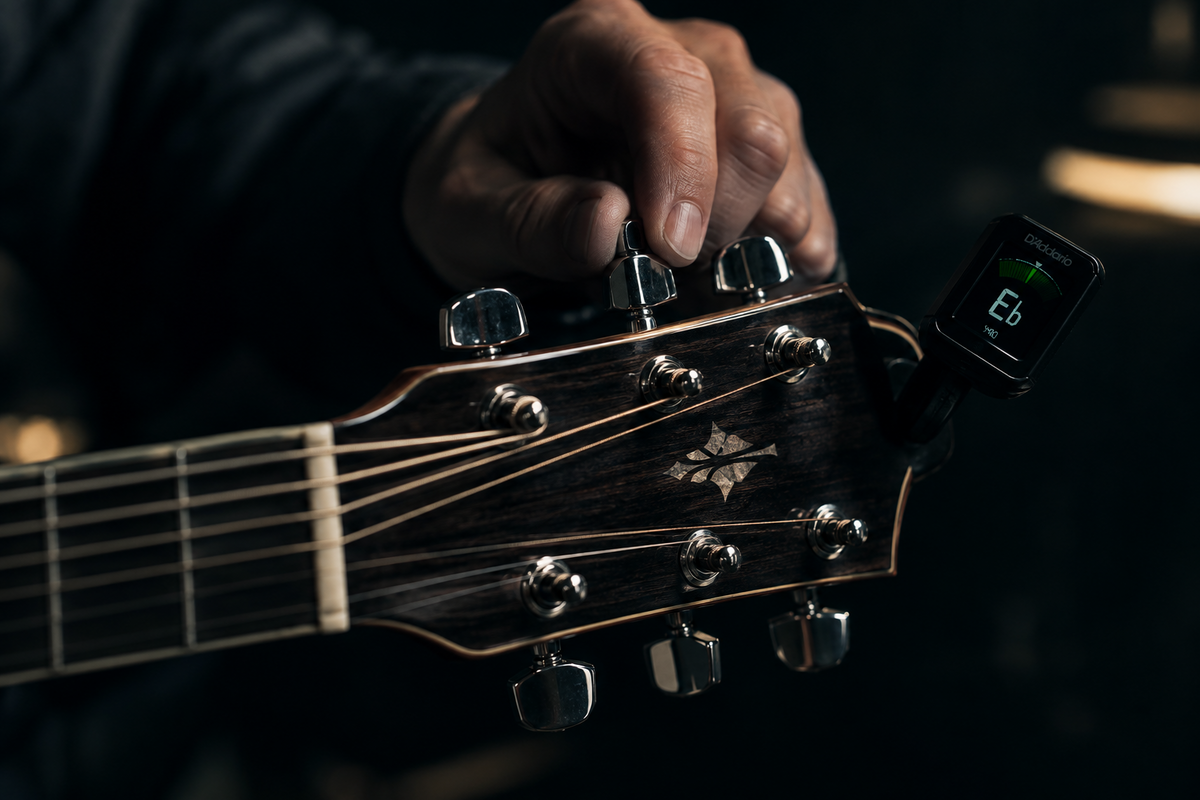
Clip-on tuners work well because they read vibration through the wood, not sound through the air.
-
Tuner apps are handy if you don’t own a physical tuner yet.
-
Either way, tune low E first, then A, D, G, then repeat the whole pass once.
Pro Tip: If your tuner flickers or won’t settle on the low E, play the 12th-fret harmonic instead of the open string. It gives a cleaner, more stable signal for tuners that struggle with low frequencies.
For most beginners, a clip-on tuner or a dedicated bass tuner app is the fastest and most reliable route to accurate tuning, ahead of tuning by ear alone.
Key Takeaways
Accurate bass tuning depends on matching each string to its correct target frequency in sequence, then confirming stability with a second pass and an intonation check.
| Point | Details |
|---|---|
| Tune in order | Start with low E, then A, D, G, always tuning up to pitch rather than down. |
| Run a second pass | Neck tension shifts as each string is brought up, so recheck all four before finishing. |
| Know your targets | Standard tuning is E1, A1, D2, G2 at roughly 41.20, 55.00, 73.42 and 98.00 Hz. |
| Watch for intonation issues | Compare the 12th-fret harmonic to the fretted note if fretted playing sounds off despite correct open-string tuning. |
| Use the right tools | Musicstreet stocks clip-on tuners, care kits, and setup tools to keep tuning stable between sessions. |
Table of Contents
What does “in tune” actually mean on a bass?
Being in tune means each string’s pitch matches a specific target frequency, not just “close enough” to itself. Pitch is how fast a string vibrates; higher frequency means higher pitch. When two pitches are nearly matched but not quite, you’ll hear a slow pulsing or wobbling sound called beating, and StudyBass explains this beating effect as the clearest audible sign you’re close but not locked in yet.
Bass strings vibrate at much lower frequencies than guitar strings, which makes small tuning errors harder to hear in isolation. Play alone and a few cents off might pass unnoticed. Play alongside a guitarist or a keyboard player, and that same error turns muddy fast.
-
A “cent” is a hundredth of a semitone. Small on paper, obvious in a mix.
-
Beating slows down and disappears as two pitches converge.
-
Bass errors hide easily solo but surface instantly in a band setting.
Standard 4-string tuning and reference frequencies
Standard tuning for a four-string bass, from lowest to highest, is E, A, D and G, written technically as E1, A1, D2 and G2. Calibrated to the standard reference pitch of A4 = 440 Hz, the target frequencies work out to approximately the standard fundamental frequencies for E1, A1, D2 and G2 when calibrated to A4 = 440 Hz.
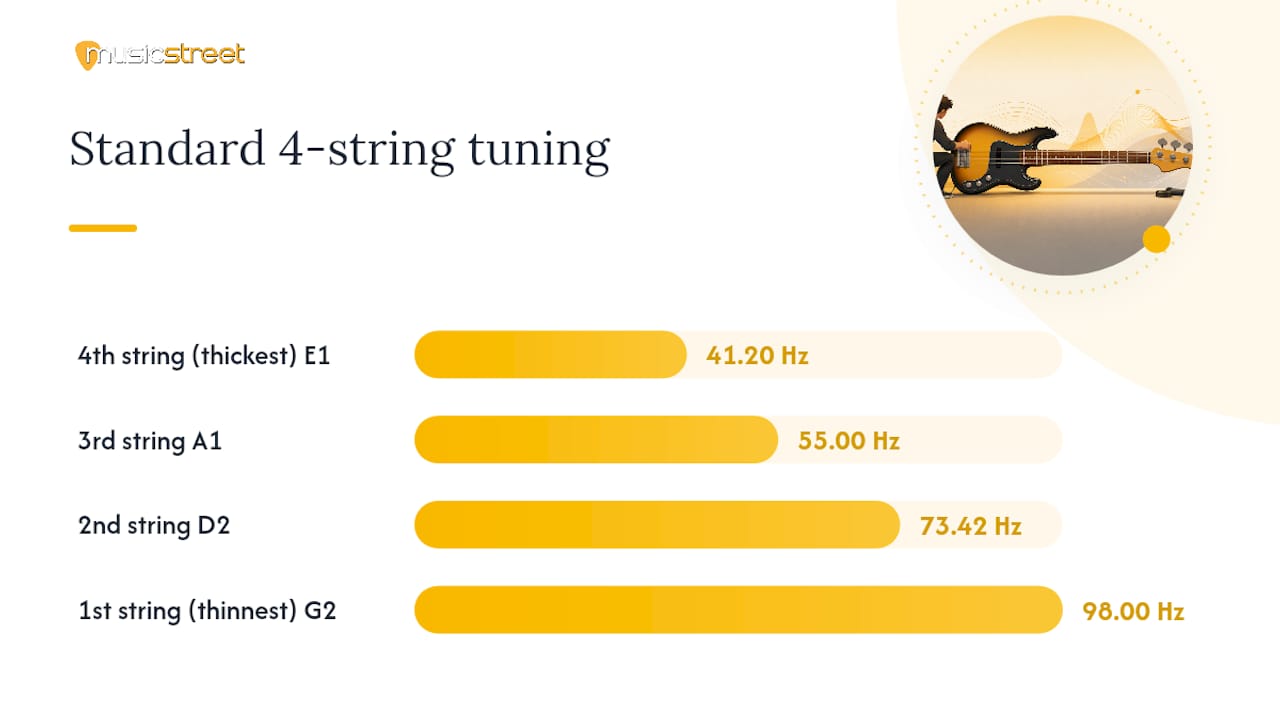
Here’s the full chart:
| String | Note | Frequency |
|---|---|---|
| 4th (thickest) | E1 | 41.20 Hz |
| 3rd | A1 | 55.00 Hz |
| 2nd | D2 | 73.42 Hz |
| 1st (thinnest) | G2 | 98.00 Hz |
If you play a 5-string with a low B, or a 6-string with a low B and high C, the pitch order extends beyond this chart. Those tunings get their own breakdown further down this guide.
Step-by-step: tuning with an electronic tuner
An electronic tuner is the quickest route to accurate pitch, provided you set it up correctly first.
-
Choose the right mode. Switch to chromatic mode if your tuner has one, or select a dedicated bass setting. Cheaper clip-on tuners sometimes struggle to lock onto low E, so bass mode helps.
-
Start with the low E. Pluck it cleanly near the middle of the string, not right by the bridge, and mute the other three strings with your fretting hand so the tuner isn’t confused by sympathetic vibration.
-
Watch the reading, not the attack. The initial pluck can spike sharp before settling. Wait for the sustained note, then adjust.
-
Tune up to pitch. Loosen the string slightly if you’ve overshot, then bring it up slowly rather than dialling down onto the note. This keeps tension even and avoids slack.
-
Repeat for A, D and G, then do a full second pass. Tightening one string always shifts the others slightly.
-
Check intonation once tuned. Compare the 12th-fret harmonic against the fretted 12th-fret note on each string. If they don’t match, that’s a setup issue, not a tuning one.
Clip-on vibration tuners are the most dependable choice in noisy rooms since they read the instrument’s physical vibration rather than airborne sound, while microphone-based apps are convenient but can lose accuracy on low E in loud spaces. Online browser tuners work fine as a backup when you’ve forgotten your usual tuner.
Pro Tip: Expect small, slow peg turns on bass strings. A quarter turn moves pitch further than it would on a guitar because the strings are thicker and under more tension.
How to tune by ear without a tuner
Tuning by ear sharpens your listening and works anywhere, no batteries required.
-
Get a reference pitch first. Use a piano, a tuning fork, a pitch pipe, or another already-tuned instrument to establish your low E.
-
Tune string to string. Fret the low E at the 5th fret; it should match the open A string. Repeat: 5th fret of A matches open D, 5th fret of D matches open G.
-
Listen for beating. As the two notes converge, the pulsing slows and vanishes. That’s your cue you’re locked in.
-
Cross-check with harmonics. Play the 12th-fret harmonic on one string and compare it against the fretted 12th-fret note on the same string. A mismatch points to an intonation problem rather than a tuning error.
Relative tuning gets your bass in tune with itself, but not necessarily with anything else in the room. Without a reference pitch to start from, you can play a perfectly consistent bass that’s still a semitone off from the piano next to it.
Always anchor the first string to a real reference before tuning the rest relatively. Skip that step and you risk a beautifully consistent, entirely wrong tuning.
Why does my bass sound wrong even when the tuner says it’s fine?
A handful of usual suspects cause this, and most take seconds to fix.
-
Sympathetic ringing. Other strings vibrating alongside the one you’re tuning can throw the tuner off. Mute everything except the target string.
-
Tuning the attack, not the sustain. The pluck spikes sharp before settling; wait a beat before trusting the display.
-
Wrong peg. Easy to grab the neighbouring tuner by mistake, especially on a headstock with tight spacing.
-
Worn or dirty strings. Old strings lose the ability to hold a stable pitch and often sound dull even when technically “in tune.”
-
Slippage at the post, or a binding nut. If a string keeps drifting flat within minutes of tuning, check the winds around the tuning post and the nut slot for snagging.
If the open string reads perfectly but fretted notes further up the neck sound consistently sharp or flat, that’s an intonation issue rather than a tuning one, and it’s worth a professional setup rather than endless retuning.
Alternate tunings and 5- and 6-string pitch orders
Plenty of bassists move beyond standard tuning once they’ve got the basics locked in. The most common variants:
-
Drop D: D, A, D, G. Only the low string drops a whole tone.
-
Half-step or full-step down: every string tuned uniformly lower, often to match a vocalist’s range or a guitarist’s detuned rig.
-
5-string standard: B, E, A, D, G, adding a low B below standard tuning.
-
6-string standard: B, E, A, D, G, C, adding both a low B and a high C.
Lower strings carry more tension and thicker gauges, so expect a slightly different feel under your fingers and a wider intonation tolerance to manage. If your tuner won’t lock onto a low B, try the 12th-fret harmonic instead of the open string; it often gives a cleaner fundamental for the tuner to read. Readers weighing up whether a 5-string suits their playing style can find more detail in this guide to 4-string versus 5-string and 6-string basses.
Keeping your bass in tune between sessions
Tuning stability starts the moment you fit a new string, not the moment you pick up the instrument.
-
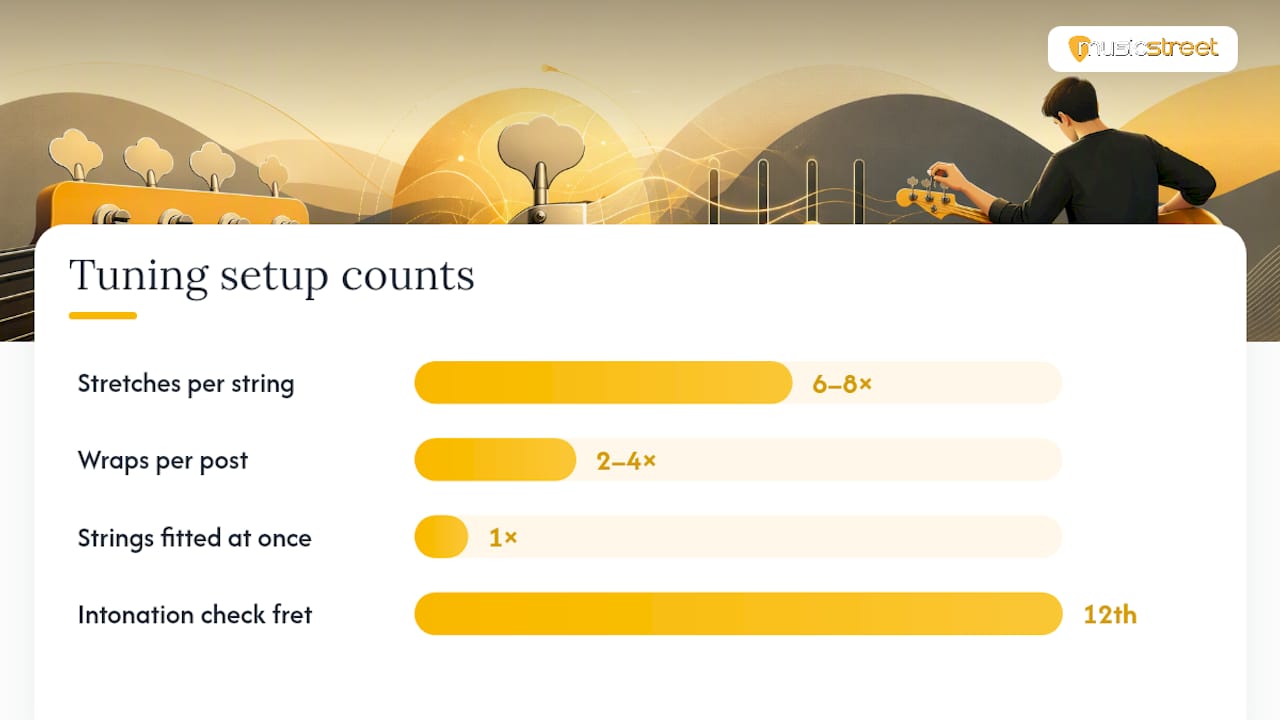
Fit strings one at a time, tune each to pitch, then stretch it gently six to eight times along its length before retuning. Repeat until the pitch holds steady, since new strings need this settling-in period to stop drifting flat.
-
Wind neatly. Aim for two to four downward wraps around the tuning post, keeping a clean break angle over the nut and trimming excess string so it doesn’t catch or buzz.
-
Store sensibly. Keep the bass somewhere with stable temperature and humidity, and loosen the strings slightly if it’s going into long-term storage.
-
Check the setup basics if tuning trouble persists: nut slots, saddle heights, and intonation via the 12th-fret harmonic against the fretted note, as Fender’s own setup guidance recommends.
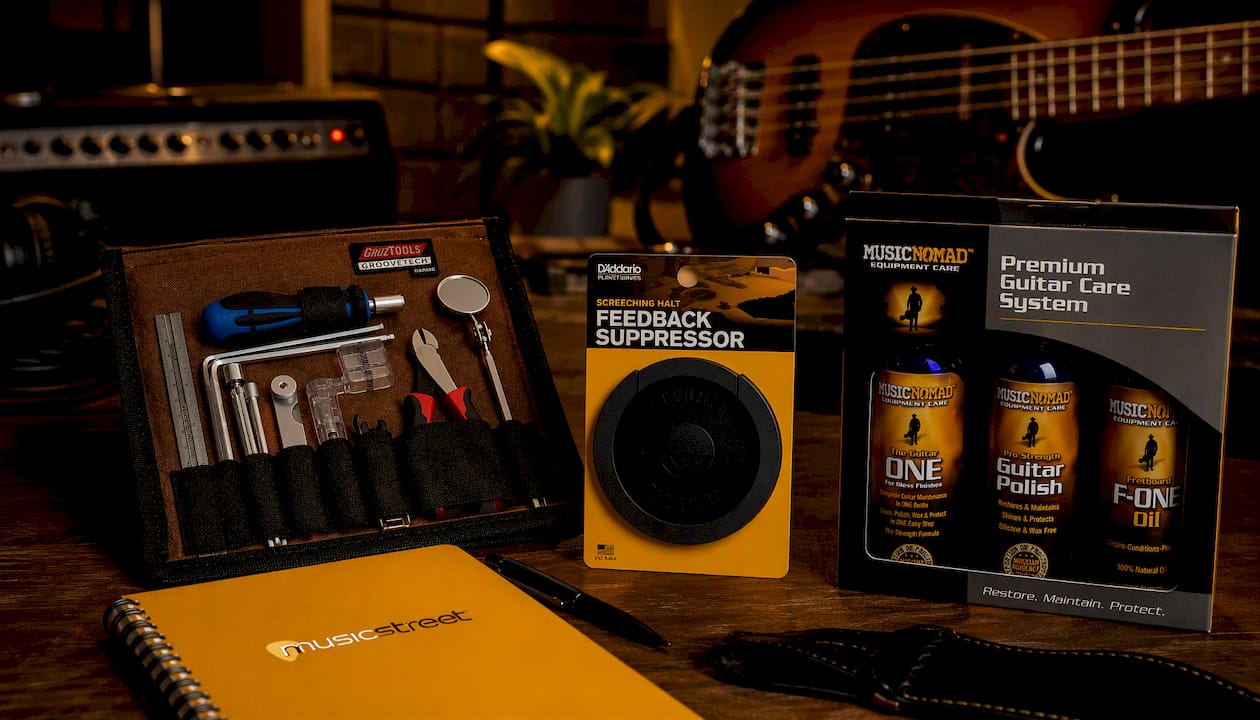
For the actual tools, a compact kit like the CruzTools Groovetech Acoustic Guitar Player Tech Kit covers most basic adjustments, while the Music Nomad Premium Guitar Care Kit handles cleaning and protecting strings and hardware between string changes. If you play live and fight feedback through a soundhole, the D’Addario Planet Waves Screeching Halt is worth having in the gig bag. Persistent intonation problems or a binding nut are jobs for a proper setup rather than more tuning.
Pro Tip: Beginners should tune every single time they pick up the bass, not just once a week. Temperature, humidity, and even how hard you played yesterday all shift string tension overnight.
What beginners get wrong about tuning
Most tuning advice obsesses over gear and skips the habit that actually matters: tuning every time, not just when something sounds obviously off. A £15 clip-on tuner used consistently beats an expensive one left in a case.
The bigger blind spot is treating tuning and intonation as the same problem. Plenty of players spend twenty minutes fighting a tuner, convinced their instrument is faulty, when the open strings were fine all along and the real issue was a saddle position throwing off notes higher up the neck. Learning to check the 12th-fret harmonic against the fretted note takes thirty seconds and saves that entire cycle of frustration.
Ear training gets undersold too. Tuner apps are genuinely the fastest tool for most beginners, no argument there. But relying on them exclusively means you never develop the listening skills that let you catch a string drifting mid-song, which happens to every bassist eventually. Learn the 5th-fret relative method alongside your tuner, not instead of it. The two skills reinforce each other rather than compete.
Get your bass properly set up, not just tuned
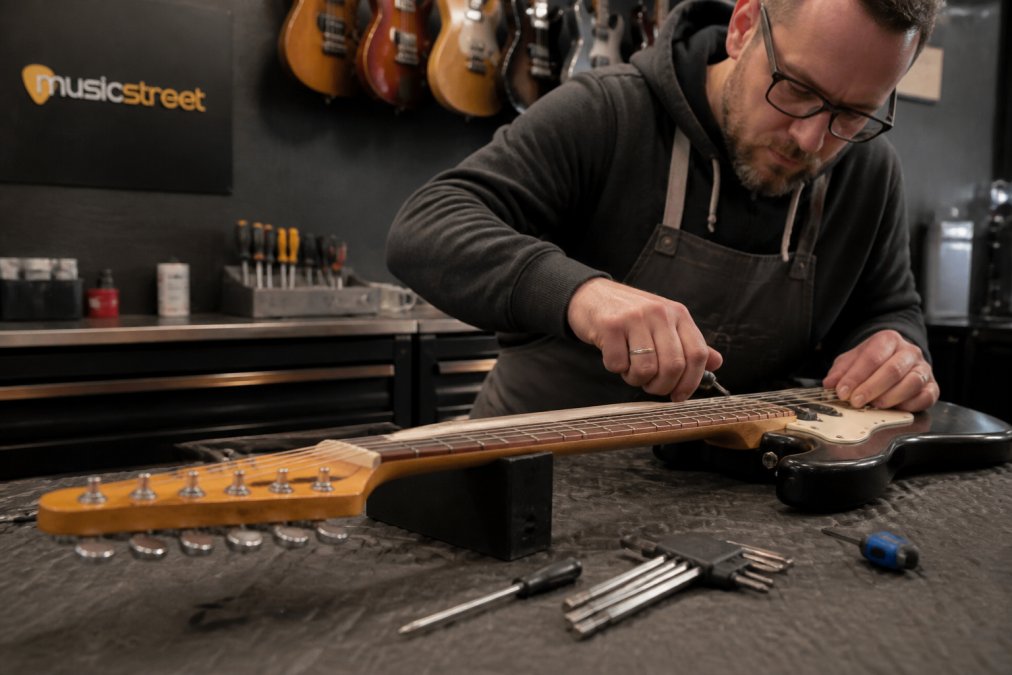
A tuner fixes pitch for tonight. It won’t fix a nut slot that’s binding, a saddle sitting at the wrong height, or strings that are too worn to hold a note reliably, and no amount of careful winding will solve those on its own. That’s where Musicstreet’s in-store setup and repair service comes in, alongside a full range of new and pre-owned basses from trusted brands, checked and set up by hand before they ever reach a customer.
If your bass keeps drifting despite doing everything right, bring it into the Huntingdon store for a professional inspection, or browse the full range of bass guitars online. For everyday maintenance, the Music Nomad Premium Guitar Care Kit and the CruzTools tech kit are both in stock and ready to ship, with free UK delivery on qualifying orders. Get in touch or pop into the shop to book a setup check.
Sources
FAQ
What is the proper tuning for a bass guitar?
Standard four-string tuning is E, A, D, G from lowest to highest, with target frequencies of roughly 41.20 Hz, 55.00 Hz, 73.42 Hz and 98.00 Hz at A4 = 440 Hz.
Can you tune a bass with a phone?
Yes, a tuner app using your phone’s microphone works well in quiet rooms, though it can struggle to read the low E accurately in noisy environments compared with a clip-on vibration tuner.
How do I tune my guitar into a bass?
You can’t retune a standard guitar to bass pitches; the strings and neck aren’t built for the tension or scale length required. A bass guitar is a different instrument, and Musicstreet’s range of new and pre-owned basses covers everything from 4-string to 6-string options.
What key do you tune a bass to?
Bass isn’t tuned to a musical key but to specific pitches: standard tuning uses E, A, D and G, with 5-string and 6-string basses extending that range with a low B or a low B and high C.
How often should I tune my bass guitar?
Tune it every time you play, since string tension shifts with temperature, humidity, and general use even when the bass has been sitting untouched.







Share:
How do you change your guitar strings: step-by-step for beginners
Which type of Fender Stratocaster should you actually buy?