

Table of Contents
- What Guitar Intonation Actually Is (And Why It Drifts)
- How to Check Guitar Intonation at Home
- Guitar Intonation Tools: What You Need and What You Don't
- The Impact of String Gauge on Intonation
- When Is Professional Intonation Setup Necessary?
- Electric vs Acoustic: Why One Is Easier to Fix
- Conclusion
- Frequently Asked Questions
Last Updated: September 22, 2026
What Guitar Intonation Actually Is (And Why It Drifts)
Guitar intonation is the accuracy with which a guitar plays in tune across the whole fretboard, not just at the open strings. When intonation is correct, a note fretted at the 12th fret matches the pitch of the open string an octave below. When it drifts, chords sound sour further up the neck even though your tuner says everything is fine.
That gap between "in tune" and "actually in tune" is where most players get confused. You tune the open strings, strum a G chord near the nut, and everything sounds fine. Move to a barre chord at the seventh fret and something feels off. That is intonation drift, and it is one of the most common complaints we hear at MusicStreet from players who assume their guitar is faulty.
So is professional intonation setup necessary? Sometimes. Not always. The honest answer depends on your instrument, your playing style, and how far the tuning drifts.
Intonation drifts for a handful of reasons. Strings stretch and wear. Temperature and humidity move the neck. A change in string gauge shifts the tension across the whole instrument. Even the way you press the strings affects pitch.
Here is the short version of what actually causes it:
- Worn or stretched strings that no longer hold pitch evenly
- A truss rod that needs adjusting as the seasons change
- Bridge saddles that have shifted or were never set correctly
- A change to heavier or lighter strings than the guitar was set up for
Most of these are fixable at home. A few are not.
How to Check Guitar Intonation at Home
You can check guitar intonation in about five minutes with a tuner and no special tools. Play the open string, note the reading, then fret the same string at the 12th fret and compare. If the 12th fret reads sharp, the string is too short. If it reads flat, the string is too long.

Work through each string one at a time. Here is the method:
- Tune the open string to pitch with your tuner.
- Fret the same string at the 12th fret and check the reading.
- Note whether it is sharp, flat, or spot on.
- Repeat for all six strings.
- Write down the results so you can track changes over time.
A small drift of a few cents is normal and often inaudible. A drift you can clearly hear in a chord is worth fixing.
The 12th fret harmonic trick works too. Compare the harmonic at the 12th fret with the fretted note. They should match. This method is slightly less accurate than using a tuner but useful if you are working by ear.
What most guides miss is that your playing style changes the reading. Players with a heavy fretting hand push notes sharp. If that is you, check intonation the way you actually play, not with a feather touch.
Guitar Intonation Tools: What You Need and What You Don't
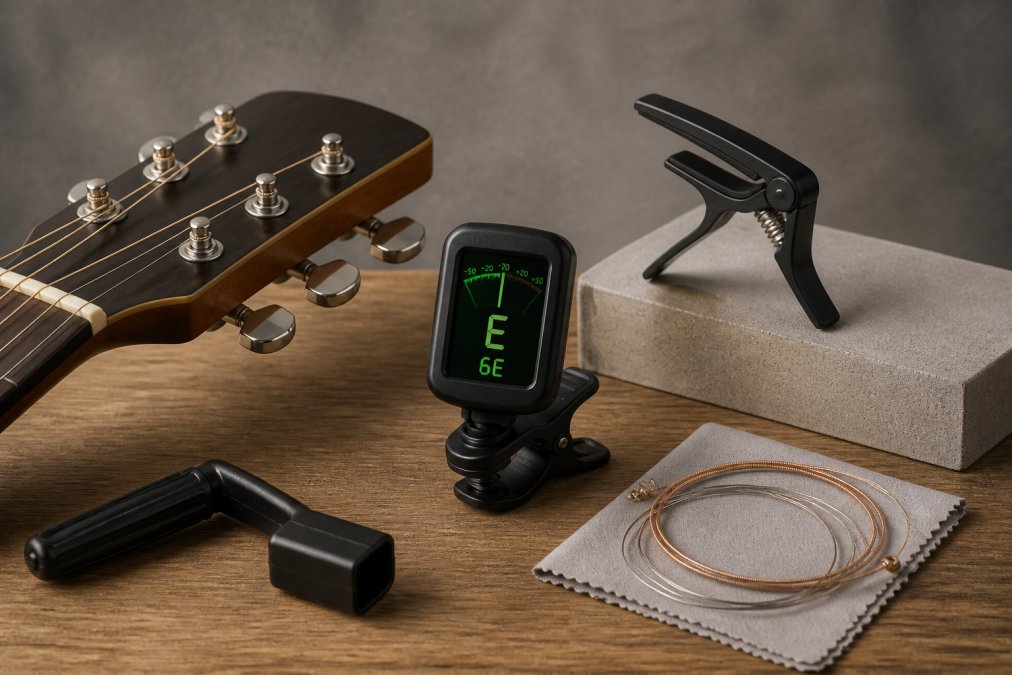
You need very little to check intonation: a reliable tuner and the right screwdriver for your bridge saddles. Everything else is optional. A clip-on tuner works fine, though a pedal or app tuner with a strobe mode gives you a more precise reading.
Here is what is genuinely useful versus what you can skip:
| Tool | Needed? | Why |
|---|---|---|
| Clip-on or app tuner | Yes | Reads pitch accurately enough for most checks |
| Small Phillips or hex driver | Yes | Adjusts saddle screws on most bridges |
| Strobe tuner | Optional | Better precision for fine adjustment |
| Feeler gauges | Optional | Measures action and relief alongside intonation |
| String winder | Optional | Speeds up string changes, not intonation work |
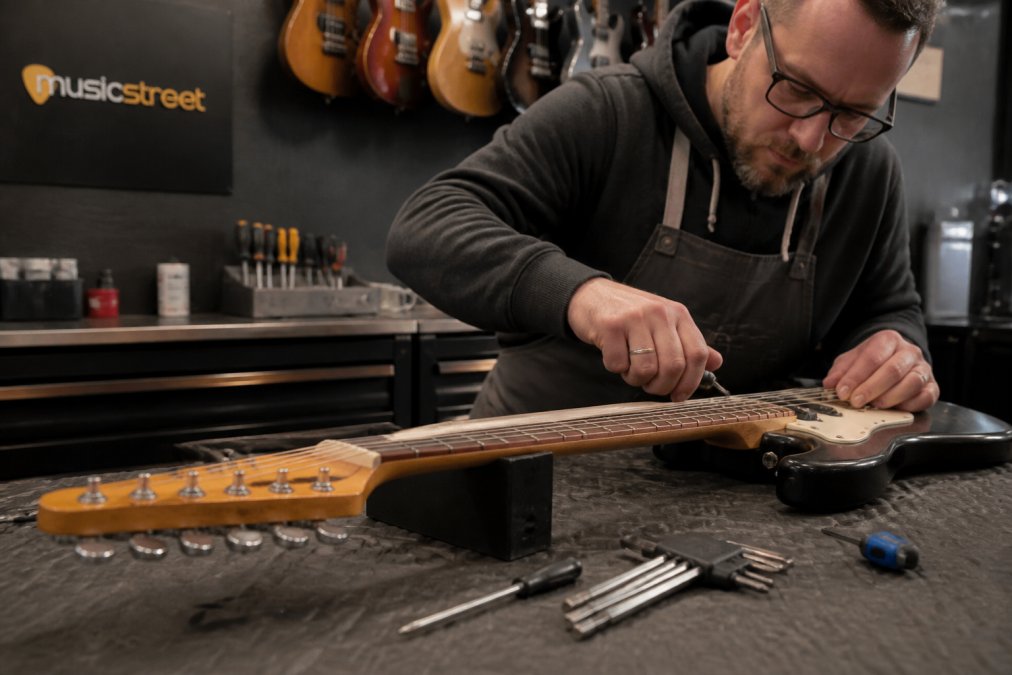
If you are adjusting an electric guitar, the tools are cheap and the job is straightforward. Acoustic guitars are a different story, and we will get to that.
The Fender guide to guitar setup and intonation walks through the process for electric models in plain terms if you want a manufacturer's reference.
The Impact of String Gauge on Intonation
Changing string gauge is the single most common reason intonation drifts. Heavier strings pull harder on the neck, which increases relief and shifts where the saddles need to sit. Lighter strings do the opposite.
If you move from a set of 9s to 10s, expect to adjust the truss rod and the saddle positions. Skipping that step is why so many players complain that their guitar "went out of tune" after a string change. It did not go out of tune. The setup no longer matches the strings.
Some players also use sweetened tunings to mask small intonation issues. This can work for recording or a specific song, but it does not fix the underlying problem. It hides it.
A few practical points on string gauge:
- Going up a gauge usually needs a truss rod tweak and saddle adjustment
- Going down a gauge often needs the same, in reverse
- Staying on the same gauge and brand keeps your setup stable for longer
- A fresh set of strings intonates more predictably than a worn set
If you change gauge often, learning to check and adjust your own intonation saves time and money. If you would rather not, that is what a workshop is for.
When Is Professional Intonation Setup Necessary?
Professional intonation setup is necessary when the drift cannot be fixed with a saddle adjustment, when the instrument is acoustic, or when the neck itself needs work beyond a simple truss rod turn. For most electric guitars with a standard bridge, you can handle it yourself. For anything structural, hand it to a technician.
Here is when to book it in:
- Your acoustic guitar plays out of tune and has no adjustable saddles
- A fret is worn, lifting, or uneven, causing pitch problems at specific frets
- The neck has a twist or a back bow that a truss rod cannot correct
- You have tried adjusting the saddles and the drift will not go away
- The nut slots are cut wrong, which throws off pitch near the first few frets
Acoustic guitars often lack the direct bridge adjustment mechanisms found on electric models, which is why they typically need expert repair rather than a home fix (Monoprice Support on guitar setup).
Electric vs Acoustic: Why One Is Easier to Fix
Electric guitars are easier to intonate because each string usually has its own adjustable saddle. You move the saddle forward or back, retune, and check again. Ten minutes of patience and you are done.
Acoustic guitars rarely have that luxury. Most have a fixed saddle, so intonation is set by the guitar's geometry: the scale length, the bridge position, and the nut. Fixing a drift often means reshaping or replacing the saddle, adjusting the nut, or addressing fret wear.
That difference explains why so many acoustic players end up in a workshop while electric players sort it out at home. It is not about skill. It is about whether the instrument gives you anything to adjust.
If you play both, a sensible habit is to check intonation on every guitar when you change strings. Catch the drift early and it stays a small job.
Conclusion
Intonation drift is one of the most annoying problems a guitarist faces, and it rarely fixes itself. If your guitar sounds sour up the neck, you have two choices: learn the home check and adjust what you can, or hand it to someone who does it every day.
At MusicStreet, we set up every guitar before it leaves us, and our in-house workshop handles the jobs that need more than a saddle tweak. Whether you are after a premium electric guitar, a hand-checked acoustic model, or a professional setup and repair service, our team of players will make sure your instrument plays in tune across the whole neck. Get started with MusicStreet and play a guitar that finally sounds right everywhere on the fretboard.
Frequently Asked Questions
How can I tell if my guitar needs intonation adjustment?
Play the 12th fret harmonic, then fret the same note and compare both readings on a tuner. If the fretted note is noticeably sharper or flatter than the harmonic, your intonation is out. You can also listen for chords sounding sour higher up the neck, particularly around the 7th to 12th frets. Regular string changes reduce false alarms, because worn strings often mimic intonation problems when the real issue is simply age and stretching.
Does changing string gauge affect guitar intonation?
Yes. Moving to a heavier or lighter gauge changes the tension across the neck, which alters the relief and the point at which each string vibrates accurately. A set of 10s swapped for 11s will usually pull the neck forward slightly and push notes sharp at the 12th fret. After any gauge change, check intonation and adjust the saddles or bridge as needed, or book a setup if you are unsure.
Can I intonate my guitar at home without special tools?
You can get close with a reliable clip-on or pedal tuner and the correct screwdriver or Allen key for your bridge saddles. Guitar intonation tools such as a strobe tuner or a dedicated saddle wrench make the job faster and more accurate, but they are not essential for a first attempt. Work one string at a time, retune after each adjustment, and expect the process to take 20 to 30 minutes.
How often should a guitar be intonated?
Check intonation every time you change strings, and again after any change in string gauge, tuning, or bridge height. Instruments kept in a stable room and strung with the same gauge may hold accurate intonation for months. If you gig regularly or travel with your guitar, a quick check before each run of shows is sensible. Acoustic guitars often need a technician because most lack adjustable saddles.






Share:
What is zero fret and how does it enhance guitar tone?
Guitar Tuning: A Step-by-Step Guide for Beginners