

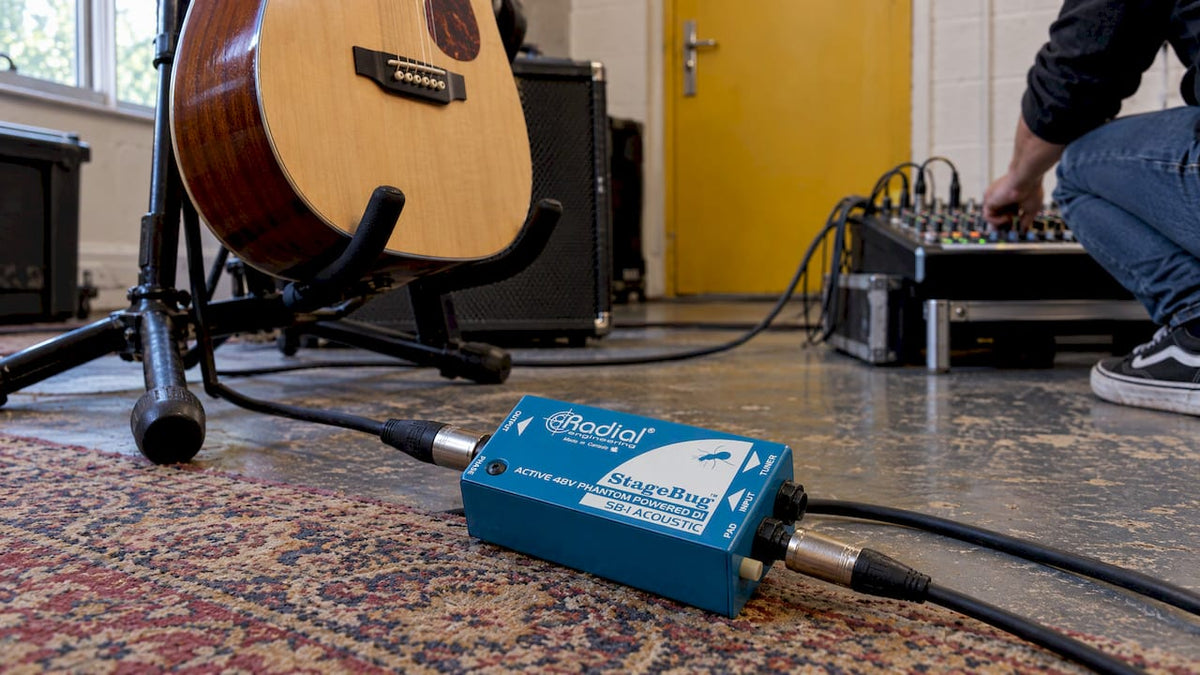
A direct box (DI box) connects your instrument straight to a mixing desk, PA or recording interface without losing tone or picking up hum. It does this by matching the instrument’s impedance, turning the signal into a balanced, mic-level one that travels down a long XLR cable, and keeping stray earth currents out of the path. If you play an acoustic with a pickup, a bass or an electric guitar that needs to reach the house system, it is one of the most useful small boxes you can own. We stock several acoustic-focused models, such as the Radial Stagebug SB-1 and the L.R. Baggs Para Acoustic D.I., and the rest of this guide explains what to look for.
Table of Contents
- What a DI box actually does
- Why a guitar cannot just plug into a desk
- Active or passive: which type suits your instrument
- How to connect a DI box to a guitar or bass
- Using a DI with an amplifier’s speaker output
- Ground lift: what it does and when to press it
- Choosing a DI box for acoustic guitar
- Our view: a DI is part of the instrument’s signal chain
- Get the right gear from MusicStreet
- FAQ
- Sources
What a DI box actually does
Sound on Sound’s Hugh Robjohns describes the DI box’s fundamental job as interfacing an instrument directly with the stage sound system, usually into a microphone preamp on the console. In practice that breaks down into a handful of tasks:
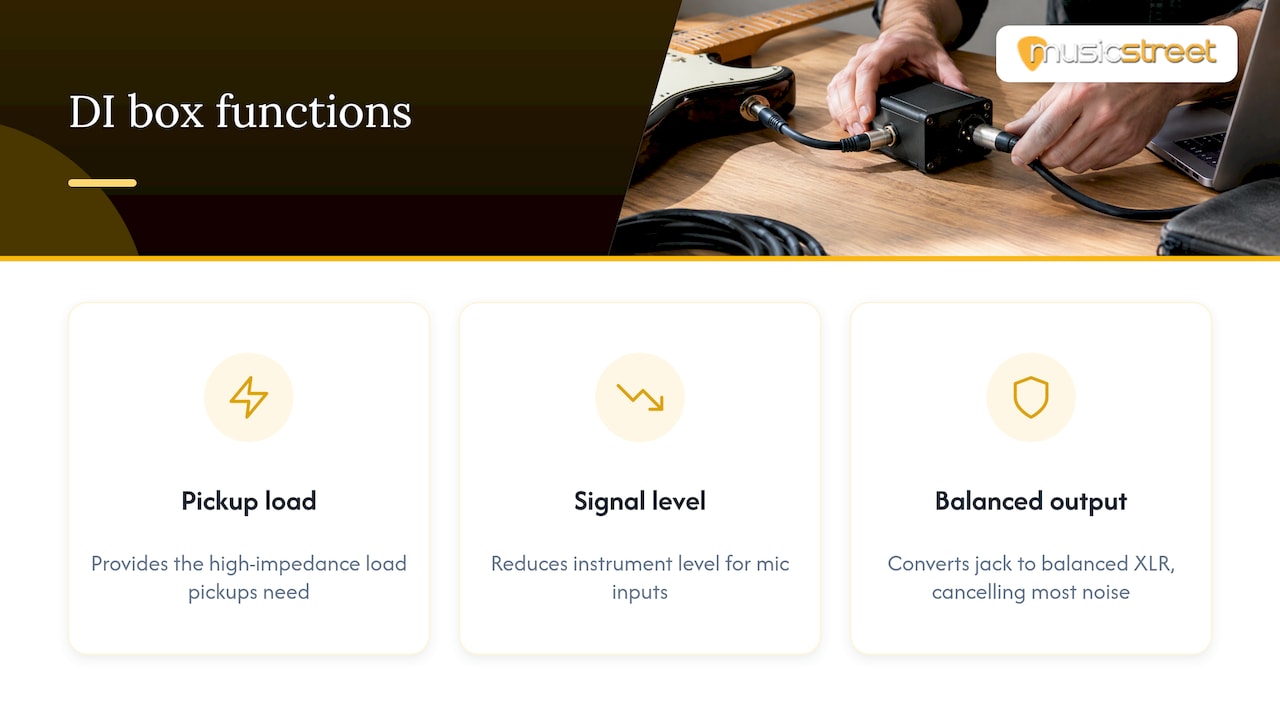
- It presents a high-impedance load to the instrument, so the pickup sounds as it should.
- It reduces the signal to roughly microphone level, which is what a desk’s mic input expects.
- It gives a low-impedance, balanced output on an XLR socket.
- It can split the signal, so one feed goes to your amp and another to the front-of-house desk.
- It isolates grounds, which helps avoid ground-loop hum, and adds electrical isolation for safety.
That is why the box is so common at gigs. The sound engineer asks for a DI because it is a clean, quiet and predictable connection, and because it lets you keep playing through your own amp at the same time.
Why a guitar cannot just plug into a desk
Three plain terms explain most of it.
Impedance is, loosely, how hard a signal source is to drive. Electric guitar pickups have source impedances of about 5kΩ to 20kΩ and, according to Sound on Sound, want to see a load of at least 250kΩ, often up to 1MΩ, to sound as intended. A microphone input is a much lower load. Plug a passive pickup into the wrong input and the top end can go dull. A DI box gives the pickup the high-impedance load it wants and then delivers a low-impedance output to the desk.
Level is how strong the signal is. The same Sound on Sound guide puts typical guitar output at about -30dBu to 0dBu, rising to around +10dBu for active basses. A mic preamp is designed to bring up very quiet signals, so the DI brings your instrument down to a level it likes.
Balanced versus unbalanced describes the cable. A standard jack lead is unbalanced and picks up interference over distance. A balanced XLR lead carries the signal in a way that cancels most of that noise, so you can run it across a stage or down a multicore to the desk. The DI does the conversion.
For a sense of real figures, the manual for a UK-made BSS AR-133 lists an input impedance of 1MΩ at its 0dB setting and a transformer-balanced XLR output that will drive lines from 600Ω upwards.
Active or passive: which type suits your instrument
There are two designs, and the choice depends mainly on your pickups.
Passive DI boxes use a transformer to step the signal down and balance it. According to Sound on Sound, they can offer up to about 150kΩ input impedance and reduce the signal by about 20dB. They need no battery or power, and passive units suit instruments with active pickups and other higher-output sources. They also tolerate strong signals well.
Active DI boxes use a buffer amplifier, typically presenting 1MΩ input impedance, and need power from a battery or the desk’s 48V phantom power, as Sound on Sound explains. They suit low-output instruments, such as electric and bass guitars and acoustics with passive pickups, and cope with a wide range of levels including very quiet ones. Very hot signals can overload an active box that lacks headroom or a pad switch.
The rule of thumb is easy to remember: passive pickups go into an active DI, active pickups go into a passive DI. If you are unsure which pickups your guitar has, our guide to active and passive pickups explains how to tell, and how each type affects tone.
| Passive DI | Active DI | |
|---|---|---|
| Power | None needed | Battery or 48V phantom power |
| Typical input impedance | Up to about 150kΩ | Around 1MΩ |
| Best with | Active pickups, high-output sources | Passive pickups, low-output instruments |
| Handles hot signals | Very well | Needs headroom or a pad |
How to connect a DI box to a guitar or bass
The standard set-up is short and the same for most boxes:
- Plug your instrument lead into the DI’s input jack.
- If you use an amp on stage, run a second lead from the THRU (or LINK) jack to the amp input. The signal passes through so you keep your own monitor sound.
- Connect the XLR output to the mixer’s microphone input with a balanced XLR cable.
- Set the pad to 0dB to start. Radial’s own JDI manual recommends this, with the -15dB pad only for exceptionally high signal levels.
- If the box is active and has no battery, make sure the desk’s 48V phantom power is switched on for that channel.
Keep levels low when you first connect things, then bring them up. That protects both the desk input and your ears.
Where to put the DI if you use pedals
Bassists and guitarists with pedalboards should think about where the feed is taken. Jon Burton advises in Sound on Sound that with pedals, the DI feed should come after the last pedal, and that taking it from the amplifier’s output also captures the pedals and the amp’s preamp. His view is that a DI suits a clean, straightforward bass sound because it picks up only the instrument, with no spill, feedback or boominess, while a microphone may serve better for a distinctive amp tone.
Why a DI sound can seem too bright
A signal taken straight from an electric or bass guitar will usually sound exaggeratedly bright and dynamic next to the sound from your speaker. Robjohns explains in Sound on Sound that the amp and speaker combination shapes tonality heavily, so a raw DI feed typically needs quite heavy processing. If you want your amp’s character on the PA, ask the engineer to blend a DI with a microphone on the cabinet, or use a box that captures the signal after the amp’s tone controls.
Using a DI with an amplifier’s speaker output
Some boxes can take the signal from the speaker terminals, so the desk gets the sound after your effects and power stage. This is the one place where a careless connection can damage kit.
- The BSS manual says the 40dB pad setting is the one for feeding from an amplifier’s speaker output. At 0dB the typical use is guitar pickups or keyboards, and 20dB is for high-output pickups.
- Sound on Sound warns that valve amps do not like failing to see a speaker, and that serious damage can occur to the amp if it is done wrong, or to the DI if the input is too big.
- Radial’s JDX 48 manual states that the unit is not a load box. The amp must be connected to a speaker or load box at all times, and you should turn the amp off before connecting or disconnecting. It also asks for speaker cables of 3m or less and allows XLR runs of up to 100m.
In short: only use a box designed for speaker-level input, set the pad correctly before you connect, keep the speaker attached and power down while you patch.
Ground lift: what it does and when to press it
The ground lift switch is the control most players are unsure about. Hum often comes from a ground loop, where current flows along cable shields between two earthed pieces of kit. On a typical box the switch breaks the earth connection on XLR pin 1 so the loop is broken. Radial’s JDI manual describes exactly this, and notes that when you go direct without using the THRU, the ground switch should stay out so the DI is grounded at the mixing console.
The sensible routine is:
- Start with the ground lift off.
- If you hear a low hum or buzz, press it and listen.
- If the hum stays, look elsewhere, such as cables, power supplies or a faulty pickup.
The switch works on the audio signal earth only. Never cure hum by removing or taping over the earth pin on a mains plug, because that can make metal casings live and is a serious electric shock risk. If you cannot trace a hum, ask a qualified electrician or the venue’s technician to check the mains.
Choosing a DI box for acoustic guitar
Acoustic players often need the most from a DI, since an under-saddle pickup is a high-impedance source that benefits from a proper preamp stage. We stock several options suited to that job:
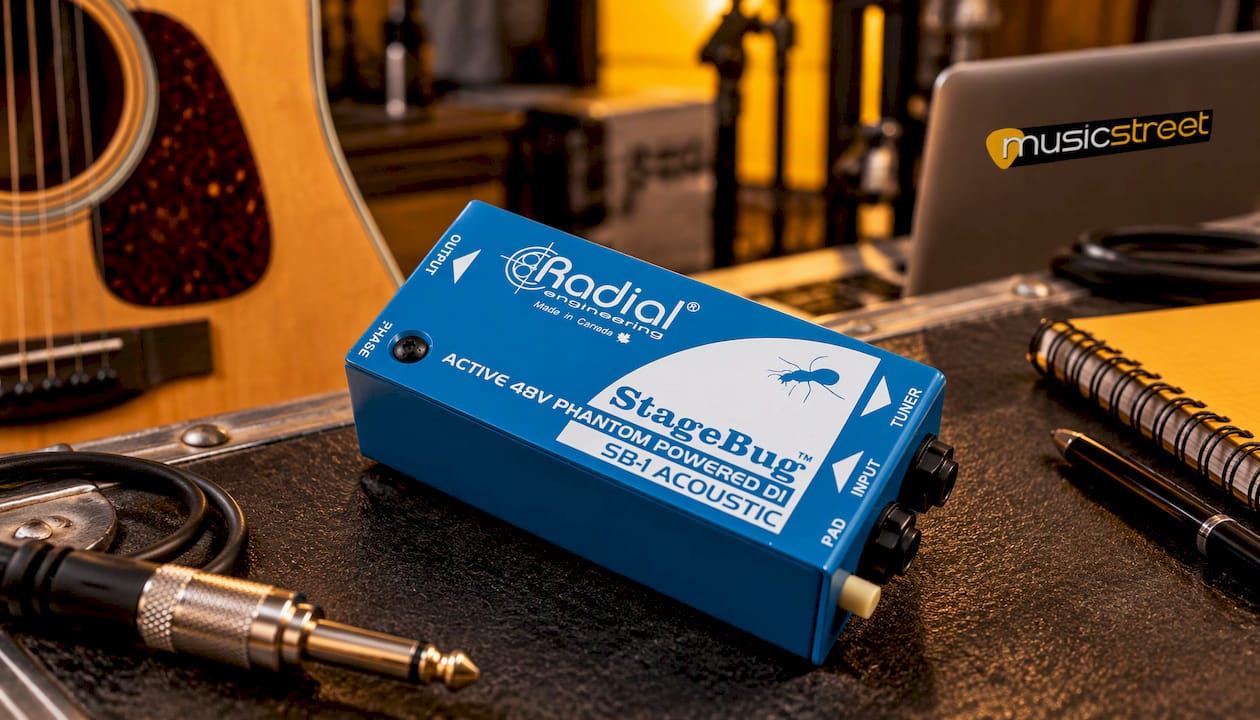
- The Radial Stagebug SB-1 acoustic DI, a compact box for getting an acoustic to the desk.
- The L.R. Baggs Para Acoustic D.I., which pairs a DI with tone shaping for an acoustic.
- The L.R. Baggs Align Series Active DI, an active design for passive-pickup instruments.
If you would rather have the DI and amp in one, the Fishman Loudbox Artist is an acoustic amplifier you can browse alongside our guitar amps and combos. For a longer walk-through of the basics, see our plain guide to what a DI box does.
Our view: a DI is part of the instrument’s signal chain
We think of a DI box as part of the guitar, not an afterthought at the back of the gig bag. The pickup, the lead, the pedals and the DI all decide what the engineer receives, and a good result starts with matching them properly.
That is why every instrument that leaves our shop is inspected and set up first. A guitar with correct action, fresh strings and working electronics gives a DI something worth sending to the desk. Hum and crackle that people blame on the box often start at a worn jack, a tired lead or a poorly set-up instrument.
Our advice is to choose the DI for the pickup in your guitar, set the pad and ground lift as described above, and try it with your own instrument. You are welcome to bring your guitar into our Huntingdon store and play through the gear, and our after-sale support is there if something does not sound right.
Music
Get the right gear from MusicStreet
Whether you need a DI for an acoustic, a new bass, or a setup that gets your current guitar gig-ready, you can find it at MusicStreet. We sell new and pre-owned electric, acoustic and bass guitars, plus amps, effects, cases and accessories, with expert setup and repairs and free UK delivery above a minimum order amount.
Browse our acoustic guitars and bass guitars, or pick up leads and other guitar accessories to complete your rig.
FAQ
How does a DI box work?
It takes the high-impedance, unbalanced signal from your instrument and converts it to a low-impedance, balanced, mic-level signal. A passive box does this with a transformer, and an active box uses a powered buffer. The result travels over XLR to the mixer without losing top end or picking up much noise.
Can you use a DI box with an amp?
Yes. Most guitar DIs have a THRU or LINK output, so the instrument feeds your amp and the desk at once. Some boxes can also take the amp’s speaker output, but only if they are designed for it, the pad is set correctly and the amp stays connected to a speaker.
Do you need a direct box?
If you only play at home through your own amp, you do not. You need one when your signal must reach a PA, mixer or recording interface over a long cable, which is common for acoustic guitars with pickups and for bass. It also gives the engineer a clean feed.
Should a DI box be on ground or lift?
Start with the ground lift off, so the box is properly grounded. If you hear a low hum caused by a ground loop, switch it to lift. If the hum is still there, the cause is likely elsewhere, such as a cable, power supply or pickup fault.
Sources
- Prepare to DI!, Sound on Sound
- Engineering Bass Guitars Live, Sound on Sound
- BSS AR133 User Manual
- Radial JDX 48 manual
- Radial JDI manual
- DI and Line Connections, UCan Play






Share:
Bass Guitar Scales: Patterns, Fingerings and Practice