


For most players, a premium padded gig bag with a semi-rigid frame is the best all-around choice in 2025: it handles daily commuting, fits in overhead lockers, and protects against the knocks that actually happen. If you fly regularly or tour, step up to a hardshell or flight case. Here are the top picks by use-case:
- Best overall: Semi-rigid gig bag with backpack straps — the right balance of protection, weight, and portability for most players.
- Best for acoustic players: A shaped hardshell case with neck cradle and internal humidifier pocket — protects the top and controls humidity.
- Best budget gig bag: A padded nylon bag with 10 mm+ foam and double-stitched seams — spend under £40 and still get meaningful protection.
- Best for travel or touring: A flight case with aluminium reinforcement and TSA-approved locks — non-negotiable if your guitar goes in the hold.
- Best for commuting: A backpack-style gig bag with padded shoulder straps and a reinforced base — frees your hands on the Tube or bus.
Pro Tip: If you own one guitar and gig regularly, consider owning two cases: a flight or hardshell for storage and travel, and a quality gig bag for everyday use. Many experienced players do exactly this, matching protection to the trip rather than forcing a single solution.
Key takeaways
The most important principle in choosing a guitar case is fit: a loose case causes damage regardless of how strong the shell is.
| Point | Details |
|---|---|
| Fit before everything else | A snug fit with no lateral movement protects better than a stronger shell on a loose case. |
| Match protection to your travel habits | Gig bags suit public transport; hardshells suit car travel; flight cases are required for air travel. |
| Foam density matters more than thickness | Press the foam at five points in-store; consistent resistance indicates quality padding. |
| Neck support is non-negotiable | A raised neck cradle prevents headstock breaks, the most common case-related guitar injury. |
| Musicstreet fitting service | Musicstreet’s Huntingdon store offers in-person case fittings that eliminate the most common return reason: poor fit. |
Table of Contents
- How do the best guitar cases 2025 compare at a glance?
- What case types are there and how much protection do they actually give?
- How do you choose the right case for your guitar?
- Mini-reviews: the best cases and gig bags to consider in the UK
- How does Musicstreet help you get the right fit in-store?
- Care, storage and travel advice for UK conditions
- Which case should you buy for your player profile?
- How do you spot a genuine quality case versus a low-quality one?
- What does brand reputation tell you about guitar cases?
- What customers ask most at Musicstreet
- Find your next case at Musicstreet
- Sources
- FAQ
How do the best guitar cases 2025 compare at a glance?
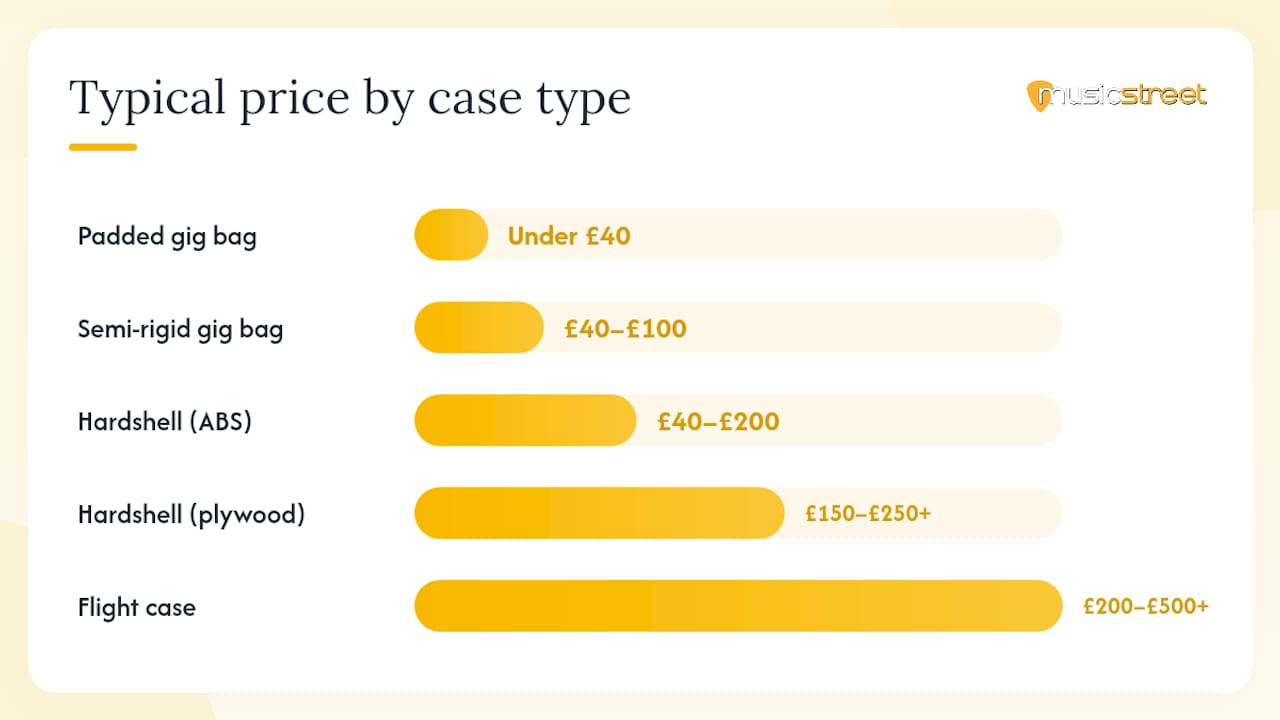
The table below covers the main protection tiers and what each offers across the dimensions that matter most for UK buyers. “Semi-rigid” here means a case with a moulded or reinforced outer shell but no rigid internal frame, sitting between a padded gig bag and a full hardshell. “Hardshell” means a rigid outer shell (ABS plastic or plywood) with carved or contoured foam inside.
| Case type | Best for | Protection level | Price band | Portability / weight | Fit / compatibility | Weather resistance | UK availability |
|---|---|---|---|---|---|---|---|
| Padded gig bag | Commuting, short local trips | Light | Budget (under £40) | Very light, backpack straps | Universal or guitar-specific | Low (nylon, no seal) | Widely available |
| Semi-rigid gig bag | Daily gigging, public transport | Medium | Mid (£40–£100) | Light to moderate | Guitar-specific recommended | Moderate (water-resistant shell) | Widely available |
| Hardshell (ABS) | Car travel, storage, local touring | High | Mid to premium (£40–£200) | Heavy, handle only | Guitar-specific | Good (sealed edges) | Widely available |
| Hardshell (plywood) | Touring, long-term storage | Very high | Premium (£150–£250+) | Heavy | Guitar-specific | Very good | Specialist retailers |
| Flight case | Air travel, heavy touring | Maximum | Premium (£200–£500+) | Very heavy | Custom or near-custom | Excellent (sealed, reinforced) | Specialist retailers |
UK transport note: If you travel by train or bus in cities, a padded or semi-rigid gig bag with backpack straps is the practical choice. Urban players tend to favour gig bags because they free both hands and fit more easily through turnstiles and onto luggage racks. Car owners have more flexibility and often prefer hardshells for the added crush resistance.
What case types are there and how much protection do they actually give?
Understanding the four main types before you buy saves you from paying for protection you will never use, or skimping on protection you genuinely need.
Padded gig bags
A padded gig bag is a fabric outer shell, usually nylon or polyester, with foam padding bonded inside. Construction quality varies enormously. A well-made bag with 10 mm or more of quality foam and dense, closed-cell padding absorbs everyday knocks well. A cheap bag with thin, open-cell foam does almost nothing. The main advantages are weight and convenience: a good gig bag weighs under 1.5 kg and fits on your back. The weakness is crush resistance. If someone sits on it, or it ends up under luggage on a coach, the guitar takes the full force.
Semi-rigid and soft-shell cases
These sit between a gig bag and a hardshell. The outer shell is moulded or reinforced, often with a polycarbonate or ABS layer, but the case does not have a rigid internal frame. Premium soft cases and semi-rigid gig bags can outperform cheap hard cases in everyday protection, precisely because their padding is better engineered and the fit is tighter. They are lighter than a hardshell and usually have backpack straps. For most gigging players who travel by public transport, this is the sweet spot.
Hardshell cases (ABS and plywood)
A hardshell case has a rigid outer shell that distributes impact across its surface rather than transmitting it directly to the guitar. ABS plastic shells are lighter and more affordable; plywood shells are heavier but more resistant to sustained pressure and temperature extremes. Hard cases are preferable for checked travel or high-risk touring, and plywood edges out ABS for long-term storage because it does not warp as readily. The trade-off is weight: a plywood hardshell can weigh 4–5 kg before the guitar goes in.
Flight cases
Flight cases add aluminium extrusion reinforcement around the edges, heavy-duty butterfly latches, and usually a custom-carved foam interior. They are built to survive baggage handlers and stack pressure. TSA-approved locks are standard on quality flight cases. The cost and weight are significant, but for any guitar going into an aircraft hold, nothing else comes close.
When to choose each type:
- Storage at home or studio: hardshell (plywood preferred for long-term)
- Daily commuting on foot or public transport: semi-rigid gig bag with backpack straps
- Gigging by car locally: hardshell ABS or quality semi-rigid
- Air travel or heavy touring: flight case
- Busking or short walks: padded gig bag (accept the trade-off)
Pro Tip: The single most reliable way to spot an overstated protection claim is to press the padding near the neck cradle. If it compresses to almost nothing under light finger pressure, the foam density is too low to absorb a real impact. Quality foam should resist compression noticeably.
For a deeper look at shell materials and lining fabrics, Musicstreet’s guide to guitar case materials covers ABS, plywood, and carbon-fibre options in detail.
How do you choose the right case for your guitar?
A structured checklist prevents the most common buying mistakes, whether you are shopping online or in-store.
The core checklist
- Fit first. The guitar should sit snugly with no lateral movement. A loose case allows instrument movement that can cause damage even when the exterior looks solid. Check body length, lower bout width, and headstock clearance.
- Neck support. Look for a raised neck cradle or neck brace. Headstock breaks are among the most common case-related injuries; a case without neck support transfers any forward impact directly to the headstock joint.
- Padding thickness and foam density. Aim for at least 10 mm of closed-cell foam for a gig bag used in transit. Thickness alone is not enough; press the foam to test density.
- Shell material. ABS for affordable hardshells; plywood for premium hardshells; aluminium-reinforced for flight cases. Chipboard cases provide almost no protection and are only marginally better than no case at all.
- Hardware quality. Test hinges and latches in-store. Latches should click firmly and not rattle. Hinges should feel solid, not flex under light pressure.
- Strap ergonomics. For any case you will carry more than five minutes, test the shoulder straps loaded. Backpack straps with sternum clips distribute weight far better than a single shoulder strap.
- Pockets and storage. Accessory pockets are useful for cables, a tuner, and a Groovetech Mini Multi-Tool for quick on-the-road adjustments. Check pocket depth and zip quality.
- Weatherproofing. In the UK, rain is a given. Hardshells with rubber seals and water-resistant gig bags with taped seams handle a downpour. An unlined nylon bag will not.
- Weight vs. protection trade-off. A flight case weighing 8 kg protects brilliantly but is impractical for a student on a bus. Match the protection level to the actual risk, not the theoretical worst case.
- Warranty and return policy. Quality case brands offer at least a one-year warranty on hardware. Check the retailer’s return policy before buying online.
Red flags to avoid
- Internal fit so loose the guitar shifts when you tilt the case
- Foam that compresses to less than 2 mm under finger pressure
- Single-stitched seams on a gig bag (they split under load)
- Cheap plastic zips with no zip-pull reinforcement
- Non-reinforced handles that attach only to the outer fabric
Quick buyer rules by scenario
- Student on foot or public transport: semi-rigid gig bag with backpack straps, minimum 10 mm foam, water-resistant outer shell.
- Gigging local band (car travel): ABS hardshell with neck cradle, rubber-sealed edges, and at least two secure latches.
- Touring professional: plywood hardshell for the van, flight case for any air travel.
Musicstreet’s guitar case vs gig bag guide walks through these scenarios with UK-specific retailer notes if you want to dig further.
Mini-reviews: the best cases and gig bags to consider in the UK
The products below span the main use-cases and price bands. Where Musicstreet stocks related instruments, those are noted as fit-compatibility references.
Yamaha FGC-TA TransAcoustic cutaway cases
The Yamaha FGC-TA TransAcoustic (available in Vintage Tint and Black) is a cutaway acoustic-electric with a body profile that sits between a standard dreadnought and a grand auditorium. It needs a case shaped for a cutaway acoustic, not a generic dreadnought shell.
Best for: Acoustic-electric players who need a case that accommodates a cutaway waist without excess internal movement.
What to look for in a case:
- Cutaway-specific internal moulding or adjustable neck support
- Humidifier pocket (the TransAcoustic’s solid spruce top benefits from humidity control)
- Minimum 15 mm padding at the body sides
Pros: A well-fitted cutaway case protects the vulnerable waist area; a humidifier pocket extends the guitar’s life in UK winter heating conditions.
Cons: Generic dreadnought cases will leave the cutaway waist unsupported, creating a rattle point.
Price band: Mid to premium for a properly fitted cutaway hardshell.
Similarly, the Yamaha FGX5 is a full dreadnought acoustic-electric. Standard dreadnought hardshells fit it well, making case selection more straightforward and affordable.
CruzTools Groovetech Guitar Player Tech Kit
The CruzTools Groovetech Guitar Player Tech Kit is not a case, but it belongs in every case’s accessory pocket. It covers the adjustments you will need on the road: hex keys, string winder, string cutter, and a screwdriver set sized for guitar hardware.
The CruzTools Groovetech Acoustic Guitar Player Tech Kit is the acoustic-specific version, with tools suited to bridge pin removal and saddle adjustment.
Best for: Any player who gigs regularly and needs a compact, purpose-built toolkit that fits in a case pocket without adding bulk.
Price band: Budget to mid (under £30).
Gretsch G5422G-12 (used) — case fit note
The used Gretsch G5422G-12 12-string electric has a semi-hollow double-cutaway body that is wider than a standard solid-body electric. Standard Strat or Les Paul cases will not fit it. You need a case specified for semi-hollow or ES-335-style bodies, with a wider lower bout clearance and a headstock area that accommodates a 12-string headstock length.
Price band: Mid to premium for a correctly sized semi-hollow case.
Ibanez GSR200 bass (used) — case fit note
The used Ibanez GSR200 is a full-scale 4-string bass. Bass cases are a separate category from guitar cases: the body is longer, the neck is longer, and the headstock is heavier. A dedicated bass gig bag or hardshell is required. Look for a bass-specific case with a reinforced neck cradle, since bass headstocks are heavier and place more stress on the neck joint during transit.
Price band: Budget to mid for a quality bass gig bag; mid to premium for a bass hardshell.
| Model / instrument | Case type needed | Padding minimum | Key fit note | Price band |
|---|---|---|---|---|
| Yamaha FGC-TA (cutaway acoustic-electric) | Cutaway acoustic hardshell | 15 mm sides | Cutaway waist support required | Mid–premium |
| Gretsch G5422G-12 (semi-hollow 12-string) | Semi-hollow electric case | 12 mm minimum | Wider lower bout, long 12-string headstock | Mid–premium |
| Ibanez GSR200 (4-string bass) | Bass gig bag or hardshell | 10 mm minimum | Bass-specific neck cradle required | Budget–mid |
For a broader look at case styles and their benefits, Musicstreet’s 7 essential examples of guitar cases is worth reading before you buy.
How does Musicstreet help you get the right fit in-store?
Getting the fit right is the single factor most buyers overlook when ordering online. Fit is the most overlooked factor in case selection, and a case that looks correct in a product photo can still allow 10–15 mm of lateral movement that causes damage over time.
How to measure your guitar for a case
- Body length: Measure from the strap button at the base to the heel of the neck. This is the minimum internal body cavity length required.
- Lower bout width: Measure across the widest point of the lower body. Add at least 5 mm each side for padding clearance.
- Neck length: Measure from the nut to the heel. The case’s neck channel must accommodate this without forcing the neck sideways.
- Headstock clearance: Measure from the nut to the tip of the headstock. The case lid must close without pressing on the tuners.
- Depth: Measure the deepest point of the body (usually at the endpin). The case cavity must exceed this by at least 10 mm to allow for padding compression.
In-store checks at Musicstreet
When you bring your guitar into Musicstreet’s Huntingdon store, the fitting process covers four points:
- Seat the guitar in the case and close the lid. The guitar should not shift when the case is tilted 45 degrees.
- Check neck bracing. The neck cradle should contact the neck shaft, not just the heel block.
- Headstock suspension. The headstock should not touch the case lid or the end wall. A 5 mm gap minimum is the target.
- Internal strap points. Any internal velcro or strap should hold the body without compressing the padding below 5 mm.
Pro Tip: The three-point feel test: with the case closed and latched, pick it up and shake it gently side-to-side, then end-to-end, then rotate it face-down. If you hear or feel the guitar move at any point, the fit is wrong. A correctly fitted case is silent.
This process is why in-store fittings at Musicstreet consistently reduce the most common return reason: a case that looked right online but allowed movement in transit.
Care, storage and travel advice for UK conditions
UK weather and transport habits create specific challenges that generic case advice does not address.
Daily care and storage
- Store cases away from direct heat sources (radiators, south-facing windows). Heat warps both the case shell and the guitar inside.
- Never leave damp items inside a case. A wet cloth or damp strap left in an accessory pocket creates a humidity spike that can lift finish and swell the top on acoustic guitars.
- For acoustic guitars, use a two-way humidification system rather than a wet sponge. Two-way systems both add and absorb moisture, keeping the internal humidity stable. A soaked sponge placed directly against the wood risks finish damage.
- Clean exterior fabrics with a damp cloth and mild soap. Wipe metal hardware dry after cleaning to prevent rust on hinges and latches.
For long-term storage guidance, Musicstreet’s guitar storage tips covers humidity targets and positioning advice.
Travel advice: checked vs. carry-on
- Carry-on: A semi-rigid or padded gig bag fits in most overhead lockers on UK domestic and short-haul European flights, but check the airline’s instrument policy before you travel. Soft cases are accepted more readily than hardshells for carry-on.
- Checked hold: Use a flight case or double-case (guitar in a hardshell, hardshell inside a flight case). Loosen string tension by a tone before checking, and remove any capo or slide from the case interior.
- Coach or National Rail: A gig bag with backpack straps is the most practical option. Hardshells can go in the luggage rack but are vulnerable to other passengers stacking bags on top.
Carrying heavier cases safely
For long walks with a heavy hardshell, use a case with a padded top handle and a shoulder strap attachment point. If the case has no shoulder strap, a luggage trolley with a bungee strap is safer than carrying by the handle for distances over 10 minutes. Gig bags with backpack straps are safer and more convenient on public transport, particularly on the London Underground where narrow gates and crowded carriages make a rigid case a liability.
Musicstreet’s guide to packing a guitar safely for travel covers UK-specific airline and rail scenarios in detail.
Maintenance checklist for zips, latches and seals
- Zips: Run a dry wax candle along zip teeth twice a year to prevent stiffening and splitting.
- Latches: Check that all latches click shut under light pressure. A latch that requires force to close is near failure.
- Rubber seals: Wipe with a silicone-based protectant annually to prevent cracking.
- Hinges: Tighten any loose screws before a trip, not after.
A note on humidity: The UK’s average indoor relative humidity in winter drops significantly when central heating runs. Acoustic guitars are most at risk between October and March. A case-based humidifier is not optional for any acoustic guitar worth over £300.
Which case should you buy for your player profile?
- Commuting student (on foot or public transport): Semi-rigid gig bag with backpack straps and water-resistant outer shell. Weight and hands-free carrying matter more than maximum crush resistance for this use-case.
- Pub and club gigging band (car travel): ABS hardshell with a neck cradle and rubber-sealed edges. The car provides the main protection in transit; the case handles the venue environment.
- Touring musician (van and air travel): Own both. A plywood hardshell for van and venue use; a flight case for any air travel. Many experienced players use a hard case for long journeys and a padded gig bag for everyday use, matching the case to the risk level of each trip.
- Studio player (minimal travel): A quality padded gig bag or entry-level hardshell is sufficient. The priority shifts to storage and humidity control rather than impact resistance.
- Collector or long-term storage owner: Plywood hardshell with a two-way humidifier system. Seal quality and internal humidity stability matter far more than portability.
For UK-specific buying advice on matching your case to your playing habits, Musicstreet’s 2025 shopping guide covers local availability and retailer notes.
How do you spot a genuine quality case versus a low-quality one?
The guitar case market has a persistent problem: cases that look professional in product photos but fail quickly in real use. Several construction details separate a genuine quality case from a poor one.
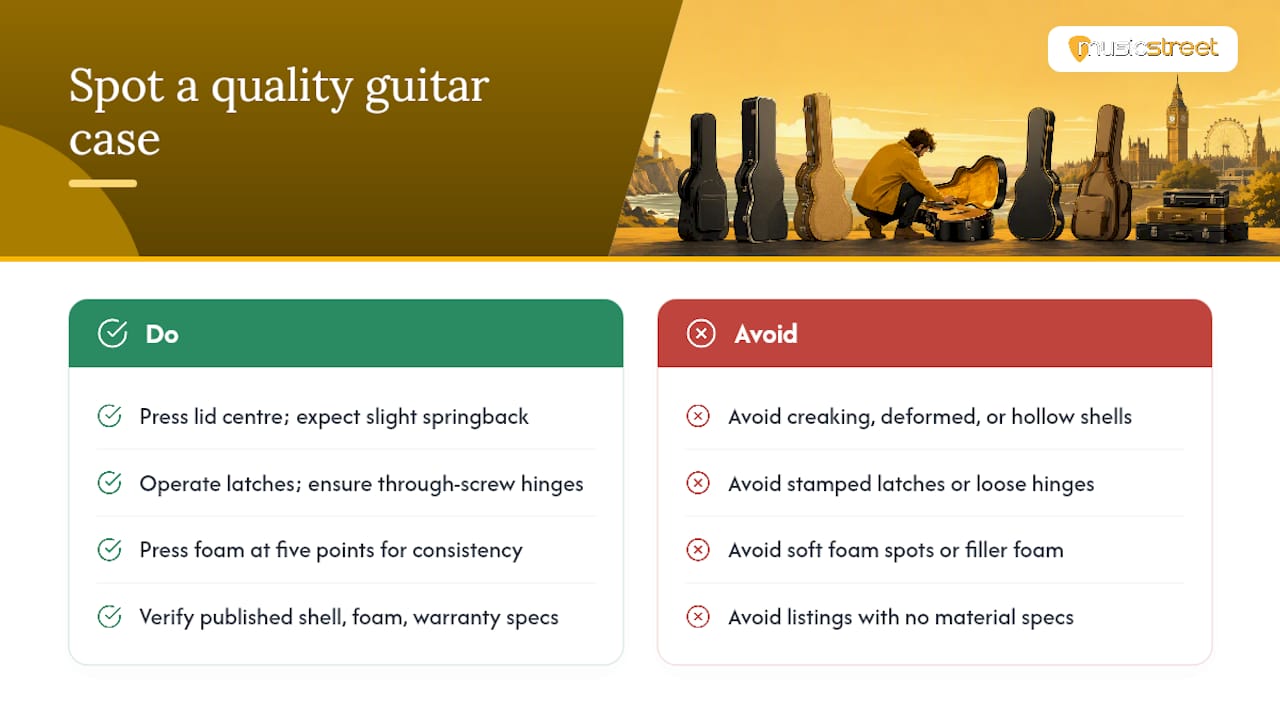
Shell integrity: Press firmly on the centre of the case lid with both hands. A quality ABS shell flexes slightly but springs back. A chipboard or thin-plastic shell will creak, deform, or feel hollow. Chipboard is the lowest-tier material and provides almost no real protection despite looking like a hardshell from the outside.
Latch and hinge quality: Cheap latches are stamped from thin sheet metal and have visible flex when you operate them. Quality latches are cast or machined and feel solid with no play. Hinges should be screwed through the shell, not just surface-mounted with short screws into the outer fabric.
Foam consistency: Open the case and press the foam at five points: both body sides, the neck cradle, the headstock area, and the centre of the body cavity. Consistent resistance across all five points indicates uniform foam density. Soft spots indicate filler foam or inconsistent manufacturing.
Seam and stitching quality: On gig bags, turn the case inside out at the handle attachment point if possible, or examine the exterior seam where handles attach. Double or triple stitching with reinforcing webbing is the standard on quality bags. Single stitching on a load-bearing seam will fail.
Brand transparency: Quality case manufacturers publish shell material specifications, foam density ratings, and warranty terms. If a product listing gives no material specifications beyond “durable shell” or “high-quality foam,” treat that as a warning sign. A premium graphite case, such as the Half-Pack Graphite Case, will specify the shell material and construction method explicitly.
What does brand reputation tell you about guitar cases?
Brand reputation in the case market is a reasonable proxy for quality consistency, but it is not a guarantee on any individual unit. A few principles apply across the market.
Established instrument brands that make cases for their own guitars (such as Yamaha) tend to produce cases with accurate internal dimensions for their instruments. The fit is engineered rather than approximate. The trade-off is that these cases are often guitar-specific and will not fit other brands well.
Dedicated case manufacturers invest more in hardware and shell engineering because cases are their core product, not an accessory line. Their warranty terms tend to be more specific and their customer support more knowledgeable about case failure modes.
Customer support signals: A brand that offers a clear warranty claim process, publishes replacement part availability (latches, hinges, foam inserts), and responds to retailer queries is one that expects its products to be used hard. Brands that make warranty claims difficult or do not stock replacement hardware are signalling that the product is designed to be replaced rather than repaired.
Retailer expertise matters here. Buying from a specialist retailer like Musicstreet means you have access to fitting advice and post-sale support that a general marketplace listing cannot provide. If a case fails within the warranty period, a specialist retailer can navigate the claim process and, in many cases, offer a replacement or alternative from stock.
What customers ask most at Musicstreet
The most common question at Musicstreet’s Huntingdon store is not “which brand?” but “will this fit my guitar?” Players arrive with a case they have already bought online, only to find the neck cradle sits too low or the headstock presses against the lid. The second most common issue is players buying a dreadnought case for a cutaway acoustic, leaving the waist area unsupported and creating a rattle on every journey.
In-store fittings change the outcome. When a player brings their guitar in and seats it in a case before buying, the fit problems that generate returns simply do not happen. The three-point shake test described earlier in this guide catches every loose-fit case before it leaves the shop. For players buying online, the measuring guide above gives the same result if followed carefully.
Find your next case at Musicstreet
Musicstreet stocks guitars and accessories for players at every level, from students buying their first gig bag to touring professionals speccing a flight case for a specific instrument. The physical store in Huntingdon offers in-person fittings where you can seat your guitar, run the three-point shake test, and leave with a case you know fits.

The online store carries accessories including the CruzTools Groovetech Guitar Player Tech Kit and the CruzTools Groovetech Acoustic Guitar Player Tech Kit to pair with your case purchase. Current stock includes instruments such as the Yamaha FGC-TA TransAcoustic in Vintage Tint and the Yamaha FGX5, with case-fit guidance available for every listed model. Visit Musicstreet to browse current stock or contact the Huntingdon store to book a fitting appointment.
Sources
- Best guitar cases and gigbags 2026: protect your instrument | GuitarPlayer
- Best guitar cases and gig bags: for electric and acoustic | Guitar World
- Cage match: gig bags vs hard cases | Seymour Duncan
- Guitar case: guide to soft bags, gigbags and hard cases | Mu
- Hardshell case or gig bag? It depends on how you’ll use it | Guitar World
FAQ
What is the best guitar case type for UK public transport?
A semi-rigid gig bag with backpack straps is the most practical choice for buses and trains. It frees both hands, fits through turnstiles, and sits on luggage racks without blocking the aisle.
How do I know if a guitar case fits my instrument?
Seat the guitar in the case, close the lid, and perform the three-point shake test: tilt side-to-side, end-to-end, and face-down. If the guitar moves or makes noise at any point, the fit is wrong. Check body length, lower bout width, and headstock clearance against the case’s internal dimensions before buying.
Do I need a flight case to fly with my guitar?
For checked hold travel, a flight case with aluminium reinforcement and TSA-approved locks gives the highest protection. A quality hardshell is the minimum acceptable alternative. Soft cases should only be used as carry-on, and only after confirming the airline’s instrument policy.
What padding thickness should a good gig bag have?
Aim for at least 10 mm of closed-cell foam for a gig bag used in regular transit. Foam density matters as much as thickness: press the padding in-store to confirm it resists compression rather than collapsing under light pressure.
Can I use a dreadnought case for a cutaway acoustic guitar?
Not reliably. A dreadnought case leaves the cutaway waist unsupported, which creates movement and a rattle point in transit. Use a case shaped specifically for cutaway acoustics, such as those suited to the Yamaha FGC-TA range, to get a proper fit around the waist.






Share:
5-string bass guitar scales: essential fretboard patterns
Guitar amplifiers for collectors: playable amps for UK players