

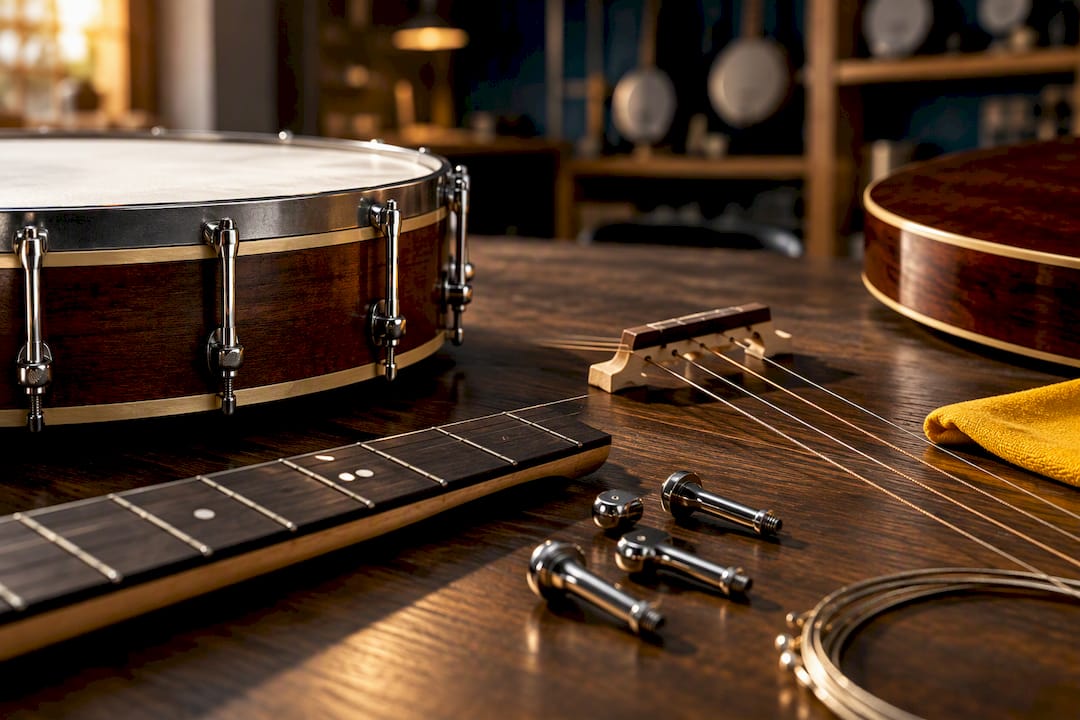
Banjos fall into a handful of clear families: the five string (the instrument most people picture, split into resonator and open back versions), four string tenor and plectrum banjos, six-string guitar banjos, and a scatter of hybrids like the banjolele and mandolin banjo. For most beginners, a five string open-back or, for guitarists making the switch, a six string guitar banjo is the simplest entry point. Whichever you choose, you’ll need decent strings and a reliable tuner from day one.
Table of Contents
- Types at a glance: matching each banjo to its music
- Profiles: what each major banjo type actually is
- How construction and specs shape the sound
- How to choose the right banjo for you
- How MusicStreet supports banjo buyers
- What actually matters when picking a banjo
- Getting set up with the right accessories
- Sources
- FAQ
Types at a glance: matching each banjo to its music
Before getting into scale lengths and tunings, it helps to see the full family side by side. Each type was built to suit a specific repertoire, and matching your goal to the right one saves months of frustration.
- Resonator 5-string: built for bluegrass, played with three-finger picking.
- Open-back 5-string: suited to old-time and folk, played clawhammer style.
- Tenor banjo: the choice for Irish traditional music and early jazz, played with a pick.
- Plectrum banjo: an early jazz staple, strummed with a plectrum.
- 6-string guitar banjo: lets guitarists play banjo tone with guitar fingerings.
- Banjolele (ukulele banjo): light accompaniment for ukulele players, strummed.
- Mandolin banjo: a rarer hybrid tuned like a mandolin, played with a pick.
- Long-neck and baritone variants: lower-pitched, used for group singing and lower keys.
- Cello and bass banjos: deep-register instruments for ensemble bottom end.
- British 7-string and fretless types: historic variants tied to a small classical and finger-style banjo tradition documented in academic research.
Profiles: what each major banjo type actually is
Each family has its own scale length, tuning and technique, and these details decide how a banjo feels under your fingers as much as how it sounds.
-
Resonator 5-string banjo. This is the bluegrass workhorse, with a closed wooden back that bounces sound forward for volume and cut. It typically runs a 26 to 27 inch scale length with 22 frets, tuned to open G (G4, D3, G3, B3, D4). Players use three-finger Scruggs-style picking with fingerpicks, driving the fast rolls associated with bluegrass breaks. Beginners chasing that bluegrass sound should start here, with fingerpicks fitted from day one.
-
Open-back 5-string banjo. Structurally the same scale and tuning as the resonator version, but without the closed back, so the tone is warmer and quieter. This is the instrument of clawhammer and frailing, where the thumb and a single finger strike down across the strings rather than picking up. It suits old-time, folk and singer-accompaniment playing. If your interest is folk music or you want something forgiving to strum around a fire, this is the natural starting point.
-
Tenor banjo. A four-string instrument with a notably shorter scale, typically 19.5 to 21.5 inches with 17 or 19 frets, tuned in fifths (C, G, D, A), the same intervalic pattern as a mandolin or violin. It is the standard banjo in Irish traditional music and was widely used in early jazz rhythm sections, usually played with a flat pick rather than fingers. Mandolin or fiddle players transfer to tenor banjo quickly because the fifths tuning and fingering patterns carry across directly.
-
Plectrum banjo. Longer than the tenor, at roughly 26 to 28 inches, also four strings, and tuned more like a guitar without the low string (commonly C, G, B, D). It belongs to early jazz and vaudeville rhythm playing, strummed chordally with a plectrum rather than picked melodically. It suits a player who wants big chordal strums rather than single-note lines.
-
6-string guitar banjo. Built with a banjo body but a guitar’s six strings and standard EADGBE tuning, so a guitarist can sit down and play familiar chord shapes while getting banjo timbre. This is arguably the fastest route into the banjo family for anyone who already plays guitar, since there’s no new tuning or fingering system to learn, only a different right-hand touch.
-
Banjolele and mandolin banjo. The banjolele pairs a small banjo body with ukulele tuning and a short scale around 13 to 14 inches, making it a natural pickup for ukulele players wanting a brighter, more percussive tone. The mandolin banjo does the same trick for mandolin tuning. Both are light, portable, and a gentle way to add banjo colour without committing to a full-size instrument.
-
Long-neck, baritone, cello and bass banjos, and historic British variants. Long-neck and baritone banjos extend the standard five-string design to lower pitches for group singing or lower keys, while cello and bass banjos push further down the register for ensemble use. Academic research into UK banjo history also documents rarer long-neck and seven-string variants tied to a small classical and finger-style tradition. These are specialist choices, not beginner instruments.
How construction and specs shape the sound
Two banjos with the same string count can sound entirely different, and the reason usually comes down to the back and the tone ring. An open-back banjo has no closed chamber behind the head, so the tone is softer and rounder, favouring finger style accompaniment. A resonator banjo bolts on a shallow wooden bowl, typically maple or mahogany, that reflects sound forward and increases volume and projection, which is why bluegrass players who need to cut through a fast fiddle tune almost always choose one. The tone ring fitted between the head and the rim also shapes the brightness and sustain of the note, and hoop diameter affects overall resonance.
Clawhammer players tend to prefer the quieter open-back setup, while three-finger bluegrass style leans on the resonator and tone ring combination for punch.
| Type | Best for | Typical scale length | Typical tuning | Technique | Back style |
|---|---|---|---|---|---|
| 5-string bluegrass | Bluegrass | 26–27 in | Open G (G,D,G,B,D) | Three-finger | Resonator |
| 5-string old-time | Folk/old-time | 26–27 in | Open G (G,D,G,B,D) | Clawhammer | Open-back |
| Tenor | Irish trad/jazz | 19.5–21.5 in | Fifths (C,G,D,A) | Pick | Either |
| Plectrum | Early jazz | 26–28 in | C,G,B,D | Pick/strum | Either |
The tenor banjo’s shorter scale length of 19.5 to 21.5 inches compared with the five-string’s 26 to 27 inches means the frets sit noticeably closer together, which is exactly why fiddle and mandolin players adapt to it so readily.
How to choose the right banjo for you
Start with your musical style, since it decides almost everything else: bluegrass points to a resonator, old-time or folk points to open-back, and Irish traditional music or jazz points to a tenor. From there, check handedness (left-handed models are far rarer and often need ordering in), whether you need volume without amplification (resonator wins here), and how much you want to carry around (open-back and smaller-bodied models are lighter).
- Play it before buying: check the action isn’t too high and there’s no fret buzz.
- Press the head: it should feel evenly tensioned, not slack in one spot.
- Check the hardware: tuning pegs and tension hooks should turn smoothly, not stick or slip.
- Ask about the return or inspection policy before committing to an online purchase.
Watch for warped necks, rattling tone rings and pegs that won’t hold pitch, all common issues on cheap or neglected instruments.
Pro Tip: Bring a clip-on tuner and a short backing track when trying a banjo in person, so you can hear how it sits in a real mix rather than just how it sounds alone.

How MusicStreet supports banjo buyers
There are specialist retailers that provide expert setup and post-sale support for instruments, ensuring they are thoroughly inspected before delivery. That inspection matters just as much for a banjo as a guitar: checking head tension, action height and hardware before it reaches you catches the problems listed above before they become yours.

Some retailers also provide educational buying guides, warranties, and delivery services on qualifying orders. Ongoing care services such as restringing and availability of starter strings and tuners can help keep a banjo playable and in tune.
What actually matters when picking a banjo
The received wisdom treats banjo choice as a beginner-versus-advanced question, when it is really a repertoire question. A brilliant bluegrass resonator is the wrong tool for old-time clawhammer, and no amount of “starter model” marketing changes that. What gets underweighted is scale length: a player struggling with a tenor’s tight 19 inch fretting or a plectrum’s stretchier 27 inch neck is often fighting the instrument’s geometry, not a lack of skill.
Construction detail gets overrated relative to fit. A pricier tone ring means little if the scale length and tuning don’t match the music you actually want to play. Prioritise matching the instrument to your repertoire first, get the setup checked properly second, and treat cosmetic upgrades as the last thing on the list.
— Music
Getting set up with the right accessories
Once you’ve settled on a type, the accessories make the difference between a banjo that stays in tune and one that fights you. The D’Addario EJ61 5-String Banjo Strings and the D’Addario EJ60 5-String Banjo Strings, Nickel, Light, 9-20 are both solid choices for tone and tuning stability on a five-string.

For accurate tuning without disturbing your playing position, the G7Th Newport Banjo 0195 is a purpose-built option worth a look. Browse the full accessories range or head to the MusicStreet landing page to book a setup.
Sources
- Frets
- Organology
- The basics of banjo construction, materials and configurations — Reverb News
- Classical banjo traditions — University of Huddersfield thesis
FAQ
What is the best type of banjo to learn on?
For most newcomers, a five-string open-back banjo is the easiest starting point because clawhammer technique is simple to pick up and the instrument suits folk and old-time repertoire. Guitarists switching over often find a six-string guitar banjo faster to learn since the tuning and chord shapes match what they already know.
What is considered the best banjo?
There’s no single best banjo, only the right type for your music: bluegrass players favour resonator five-strings for volume and cut, while Irish traditional and jazz players lean on tenor banjos for their shorter, fifths-tuned neck. The right choice depends on the repertoire, not a universal ranking.
Which is easier, clawhammer or bluegrass?
Clawhammer, played on an open-back five-string, is generally considered more approachable early on because it uses a simple down-picking motion with the thumb and one finger. Bluegrass three-finger picking on a resonator banjo takes longer to build speed and independence between fingers.
Which is better, a 4 or 5-string banjo?
Neither is universally better: a four-string tenor or plectrum banjo suits Irish traditional music and jazz rhythm playing, while a five-string suits bluegrass and old-time styles. Choose based on the music you want to play rather than the string count alone.




Share:
Play a four bar riff from tab: Read guitar tablature for UK beginners