


This page is a series-organised catalogue of Ibanez guitar models spanning electric, bass and acoustic lines, with fast identification steps and UK price guidance built in. Whether you already own an Ibanez and want to pin down exactly what it is, or you’re shopping for one and need to understand how the range is structured, this is the reference to bookmark.
Quick navigation — jump to what you need:
- Find by series: RG, S, AZ, JEM/J-Line, JS, SR, Artcore (AS/AF/AG), Talman, SA, Roadstar, GIO, Prestige, J.Custom, Premium, Iron Label, RGD/RGA/RGT/RX
- Identify your guitar: serial numbers, headstock marks, model codes
- Check likely price bracket: GIO through to J.Custom tier guide
- Verify authenticity: serial decoders, official specs, community model lists
Key takeaways
Ibanez’s tier system (GIO through to J.Custom) is the single most reliable guide to expected quality, factory origin and price, and the serial number prefix is the fastest way to confirm what tier and factory a specific guitar actually came from.
| Point | Details |
|---|---|
| Use the tier system first | GIO to J.Custom maps directly to factory origin, build quality and price bracket. |
| Serial prefix confirms origin | F/H/J = Japan; C = Korea; I = Indonesia; Z = China. Decode before agreeing a used price. |
| Premium is the value sweet spot | Indonesian Premium models now rival older Prestige builds for players on a budget. |
| Verify modifications before buying | Pickup swaps, refinishes and non-original hardware affect value; check solder joints and routing. |
| Musicstreet for UK buyers | Pre-owned Ibanez guitars are inspected and set up before sale, with free UK delivery on qualifying orders. |
Table of Contents
- How Ibanez organises its models: series, tiers and sub-series
- The complete Ibanez guitar models list: series by series
- The most popular and influential Ibanez models
- How to identify the exact Ibanez model and production year
- Typical price ranges and UK availability
- Musicstreet stocks new and pre-owned Ibanez guitars across the UK
- Sources
- FAQ
How Ibanez organises its models: series, tiers and sub-series
Understanding the Ibanez catalogue is much easier once you grasp three distinct layers: the series, the sub-series, and the quality tier. Confuse them and you’ll misread a listing or overpay for a guitar that isn’t what it claims to be.
A series is the broad model family, defined primarily by body shape and intended playing style. The RG, S, AZ and Artcore are all series. A sub-series sits inside a series and typically signals a specific construction or scale variation. The RG series, for example, contains the RGA (arched top), RGD (extended scale for down-tuning), and RGT (neck-through construction) as sub-series. These share the RG DNA but differ meaningfully in build and feel.
A quality tier cuts across all series and tells you where a model sits in Ibanez’s manufacturing hierarchy. The five main tiers, from entry-level to flagship, are:
| Tier | Typical factory origin | Construction traits | Price bracket (new) |
|---|---|---|---|
| GIO | Indonesia / China | Bolt-on, basswood or poplar body, budget hardware | Entry-level range |
| Standard | Indonesia / Korea | Bolt-on, improved hardware, wider finish options | Mid-range affordable |
| Premium | Indonesia (supervised) | Bolt-on or set-neck, upgraded pickups, better fretwork | Higher mid-range |
| Prestige | Japan (FujiGen / Sugi) | Neck-through or bolt-on, premium hardware, tight QC | Premium range |
| J.Custom | Japan (FujiGen) | Flagship spec, exotic tops, hand-selected components | Flagship/collector level |
Independent retailer guides consistently treat this five-tier hierarchy as the most reliable shorthand for expected quality and price, and it’s the framework most UK buyers use when comparing listings.
Pro Tip: If you’re buying to play rather than collect, the Premium tier is often the sweet spot. Indonesian production quality has improved substantially over the past decade, and many Premium models now rival older Prestige builds for players on a budget. If you’re buying to collect or resell, stick to Prestige or J.Custom and verify the serial confirms Japanese manufacture.
The complete Ibanez guitar models list: series by series
What follows covers every major Ibanez series, with key traits, typical variants and the player profiles each one suits. The Ibanez Wiki on Fandom is the best community-maintained cross-reference for rare runs and year-by-year model entries when you need to go deeper than this guide.
RG series
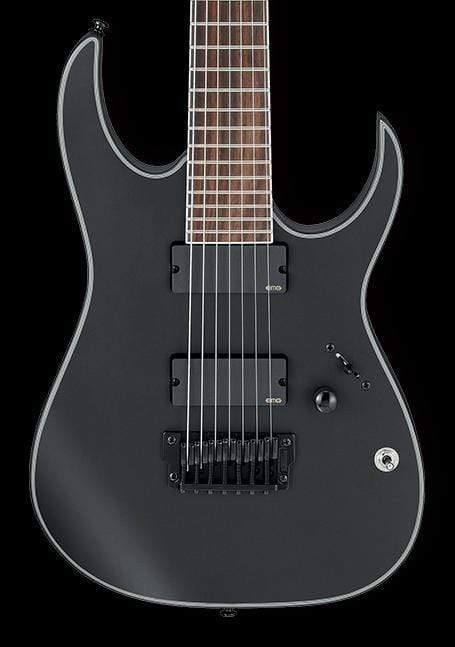
The RG is Ibanez’s most iconic electric line and its most flexible platform. The first model, the RG550, launched in 1987, and the series has since expanded into more sub-variants than any other Ibanez family. The defining traits are a double-cutaway solid body, a thin ‘Wizard’ neck profile with 24 frets, and a floating tremolo system (typically an Edge, Lo-Pro Edge, or ZR variant depending on era and tier).
Common RG sub-series and what distinguishes them:
- RGA: Arched top, introduced around 2005. Gives the RG a slightly more premium visual character and marginally different resonance.
- RGD: Extended scale (26.5" or 27"), designed for down-tuning and seven- or eight-string configurations. Popular in djent and progressive metal.
- RGT: Neck-through construction for enhanced sustain and upper-fret access.
- RGV / RX: Budget-oriented variants, often found in the GIO or lower Standard tier.
- Iron Label (RGIR / RGIX): Stripped-back, no-frills spec aimed at high-gain players who want function over aesthetics.
The RG550 itself remains one of the most searched models in the range. Original Japanese-made examples from 1987 to the mid-1990s carry a premium on the used market, particularly in candy apple red or desert sun yellow. For a detailed head-to-head between the RG and its closest sibling, Musicstreet’s RG vs S series guide breaks down the construction and playability differences clearly.
S series
The S (Saber) series trades the RG’s angular look for a thinner, contoured mahogany or basswood body that makes it noticeably lighter on the strap. The body depth is roughly half that of a standard double-cut, which suits players who find heavier guitars fatiguing. Scale length is typically 25.5", and most models carry a floating tremolo. The S series spans GIO through Prestige tiers, with the Prestige S5470 and S6570 representing the top of the line.
AZ series
Launched in 2019, the AZ is Ibanez’s answer to players who want the brand’s build quality with a slightly more traditional feel. The neck profile is rounder than the Wizard, the body contours are more pronounced, and the pickups lean toward versatile, clean-friendly tones rather than pure high-gain output. The AZ Prestige and AZ Premium variants have become popular with fusion and modern rock players. The AZ2402 and AZ2204 are the flagship Prestige models most commonly stocked in the UK.
JEM / J-Line
The JEM is Steve Vai’s signature series, introduced in 1987 alongside the RG550. Its most recognisable features are the ‘monkey grip’ handle routed into the body, the floral or vivid graphic finishes, and the Lo-Pro Edge tremolo. The JEM777 in its original Loch Ness Green, Desert Yellow and Shocking Pink colourways is among the most collectible Ibanez guitars ever made, making it a must-see for vintage band tee collectors interested in classic music collectibles. The J-Line (JEMJR and related models) brings the JEM aesthetic to a more accessible price point without the full Prestige spec. For a thorough breakdown of JEM and PIA signature traits, Musicstreet’s JEM and PIA guide covers the full history.
JS series
Joe Satriani’s signature line, the JS, uses a more aerodynamic body shape than the RG, with a slightly offset double-cut that Satriani developed for comfort during extended live performances. The JS1000 and JS2400 are the most recognised models. All JS guitars are made in Japan and sit at Prestige level or above.
PGM / FRM series
The PGM is Paul Gilbert’s signature, characterised by its scalloped upper frets (from the 21st fret upward on most models) and a distinctive ‘disappearing pyramid’ inlay pattern. The FRM is Paul Gilbert’s more recent acoustic-electric signature. Both series are Japan-made and produced in limited runs, which makes them sought-after on the used market.
SA series
The SA uses a double-cutaway body with a slightly arched top and a set-neck construction, which is unusual in the Ibanez range. It sits between the RG’s bolt-on feel and the Artcore’s hollow warmth, making it a reasonable choice for players who want some tonal depth without going fully hollow. Most SA models carry HSH or HSS pickup configurations.
Artcore series (AS, AF, AG, AGB)
The Artcore is Ibanez’s hollow and semi-hollow range, and it covers a lot of ground. The AS series (AS73, AS93, AS153) are thinline semi-hollows modelled loosely on the classic double-cutaway semi-hollow format. The AF series are full-hollow archtops. The AG is a smaller-body full-hollow. The AGB is the bass variant of the Artcore concept.
The AS73 in particular has become a go-to recommendation for jazz and blues players on a budget. It’s a set-neck, laminate maple body guitar with a 24.75" scale and a pair of Ibanez ACH humbuckers, and it consistently punches above its price point.
Talman series (TC, TM, TMB)
The Talman has an offset double-cut body shape with a retro 1960s character. The TC series are solid-body electrics, the TM series are acoustic-electrics, and the TMB is the bass variant. The Talman is not a high-gain guitar; it suits indie, pop and clean-toned playing.
Roadstar series
The Roadstar (RS) was Ibanez’s main workhorse series through the late 1970s and 1980s, before the RG took over. Roadstar models are bolt-on, solid-body guitars with a more conventional Stratocaster-influenced shape. They’re now primarily of interest to collectors and players who want a well-made Japanese guitar from that era at a reasonable used price.
SR bass series
The SR (Soundgear) is Ibanez’s flagship bass line and one of the best-selling bass series in the world. The body is slim and lightweight, the neck is narrow at the nut (typically 38mm for a four-string), and the construction spans bolt-on at the entry level through neck-through at the top. The SR300, SR500, SR800 and SR1200 are the most commonly encountered models in the UK. The used Ibanez GSR200 bass represents the entry point of the Soundgear family, and the new GSR200 in black and walnut flat finish are solid starting points for bass players new to the brand.
GIO series
GIO is Ibanez’s entry-level sub-brand, covering electric, bass and acoustic models. The GSA60, GSA73, and GRG series are the most common GIO electrics. Build quality is functional rather than exceptional, but GIO guitars are correctly set up and play well for beginners. The used Ibanez GSA60 in walnut is a good example of what GIO delivers at a sensible price.
Prestige line
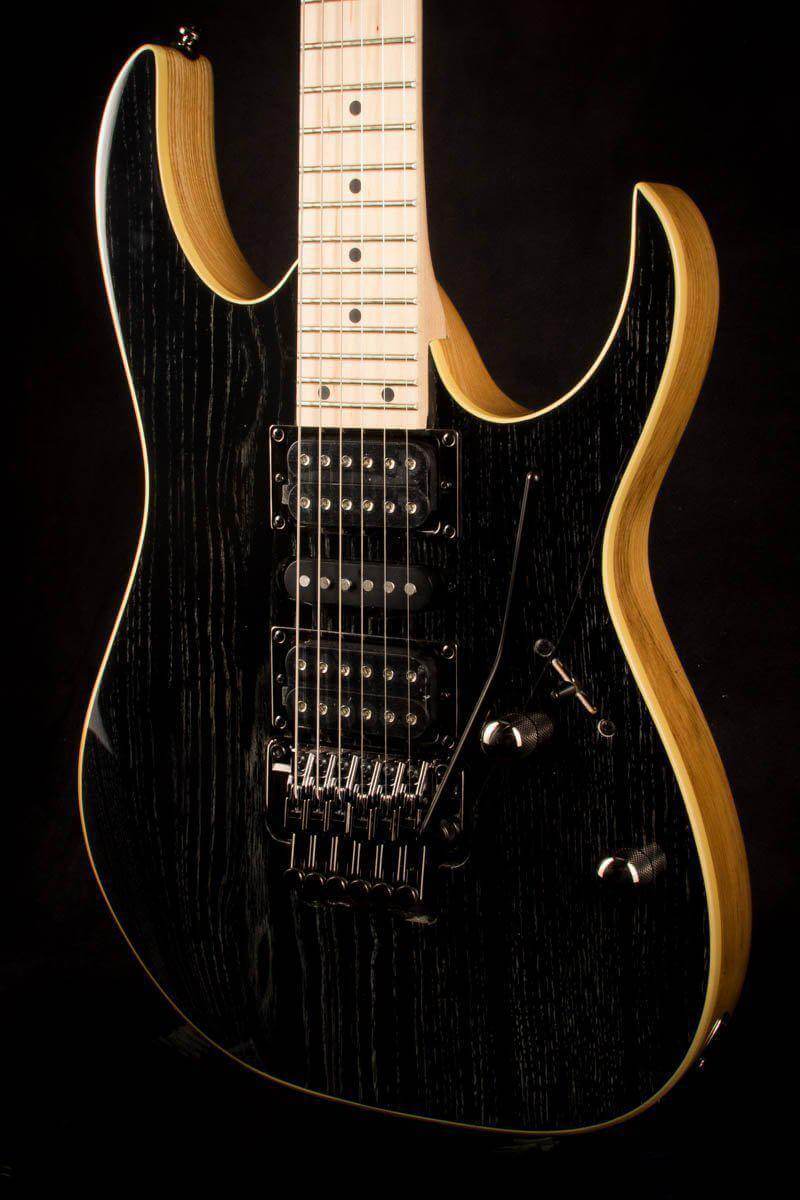
Prestige is not a series in itself but a quality designation applied to top-spec models within the RG, S, AZ, SR and other series. All Prestige guitars are made in Japan, typically at FujiGen or Sugi. They carry premium hardware (Edge Zero II, Gotoh tuners), tighter fretwork tolerances, and better finishing than their Indonesian counterparts. The serial prefix ‘F’ (pre-1997) or ‘J’ (post-2004) on a Japanese-made guitar is a strong indicator of Prestige-level manufacture.
J.Custom
J.Custom is the absolute top of the Ibanez range, produced in very limited numbers at FujiGen in Japan. Models typically feature exotic wood tops (quilted maple, flamed maple), hand-selected hardware, and specifications that go beyond what the standard Prestige line offers. J.Custom models are sold primarily in Japan and through specialist importers in the UK, which makes them relatively rare in the domestic used market.
Premium line
Premium sits between Standard and Prestige. These are Indonesian-made guitars built to tighter tolerances than Standard models, often with upgraded pickups (DiMarzio, Bare Knuckle on some variants) and better hardware. The RG Premium and S Premium are the most common. For players who want near-Prestige quality without the Prestige price, Premium is the tier to focus on.
Iron Label series
Iron Label models (RGIR, RGIX, SIX, SRIH) are stripped-down, high-gain instruments with no tone knob, minimal aesthetics, and pickups voiced for heavy music. They’re available in both Standard and Premium tiers. The extended-scale Iron Label models (27" and 28") are particularly popular for seven- and eight-string players in the UK metal scene.
RGD / RGA / RGT / RX
These sub-series sit within the broader RG family but deserve a separate mention because they’re frequently searched independently. The RGD is the extended-scale variant (26.5" standard), the RGA has an arched top, the RGT uses neck-through construction, and the RX is an older budget variant from the 1990s and early 2000s. The RX series is now discontinued but turns up regularly in used listings.
The table below summarises the major series across the key comparison dimensions:
The most popular and influential Ibanez models
A handful of models define what Ibanez means to most players. These are the ones that come up repeatedly in retailer guides, forum discussions and used listings.
RG550 (1987): The guitar that started the modern Ibanez story. Original Japanese examples in the classic colourways (Road Flare Red, Desert Sun Yellow) are among the most traded used Ibanez guitars in the UK. The 550 set the template: Wizard neck, Edge tremolo, 24 frets, HSH configuration.
JEM777 (1987): Steve Vai’s original signature, produced in Japan in three launch colours. The monkey grip, the Lo-Pro Edge, and the tree-of-life inlay on higher-spec variants make it instantly recognisable. Early examples in original condition command significant premiums. Musicstreet’s JEM and PIA guide covers the full signature lineage.
JS1000 / JS2400: Satriani’s signature models, both Japan-made. The JS body shape is more compact than the RG, with a slightly different upper horn that Satriani designed for stage comfort. The JS2400 is the current flagship.
PGM301 / PGM100: Paul Gilbert’s signature, notable for the scalloped upper frets and the ‘disappearing pyramid’ inlay. Limited production runs mean clean examples hold value well.
AZ2402 / AZ2204: The current Prestige AZ flagships. These have become the recommended starting point for players who want a Japanese-made Ibanez with a slightly more conventional neck feel than the Wizard profile.
AS73 / AS93: The Artcore semi-hollows that introduced a generation of players to jazz and blues on a budget. The AS73 in particular has an almost cult following among players who want a giggable semi-hollow without spending Prestige money.
SR800 / SR1200: The mid-to-upper SR bass models that represent the sweet spot of the Soundgear range for working bassists. Neck-through construction on the SR1200 gives it noticeably more sustain than the bolt-on SR800.
Limited editions and J.Custom exclusives: Ibanez releases J.Custom models in very small batches, often with unique finishes and hardware combinations not available in the standard catalogue. These are tracked most reliably through the Ibanez Wiki model lists, which document year-by-year production runs including limited and regional exclusives.
For a curated list of the best Ibanez models specifically for heavy music, Musicstreet’s metal guitar guide covers the RG, Iron Label and RGD options across tiers.
Worth knowing: The RG platform has been Ibanez’s most flexible base, spawning arched-top, neck-through and extended-scale variants that widened its appeal from shred to djent and progressive styles. No other Ibanez series has been adapted as widely or remained in continuous production as long.
How to identify the exact Ibanez model and production year
The serial number and model code are the fastest route to a precise identification. Here’s the step-by-step process.
-
Check the back of the headstock. Most Ibanez electrics from the 1980s onward have the serial number stamped or printed on the back of the headstock. On older models (pre-1987), it may be on a neck plate.
-
Check inside the soundhole for acoustics. Ibanez acoustic guitars carry a label inside the body with the model code and serial number. Use a torch and a mirror if the label is set back from the soundhole.
-
Locate the model code. On most post-1990 guitars, the model code is printed on the headstock front (e.g. “RG550” or “S470”). On older or budget models, it may only appear on the label inside the cavity or on the original hang tag.
-
Decode the serial prefix. Serial-prefix conventions give you the factory and approximate era: F = Japan (FujiGen), 1987–1997; H = Japan, 1997–2003; J = Japan, 2004 onward; C = Cort, Korea; I = Indonesia; Z = China. The digits following the prefix typically encode the year and month of manufacture.
-
Run the serial through a decoder. The Guitar Dater Project’s Ibanez decoder supports 14 factories and seven serial formats, and it’s the most widely used tool for narrowing production date and factory origin. Enter the full serial including the prefix letter.
-
Cross-check against the model list. Once you have a production year, use the Ibanez Wiki model numbers page to confirm whether the spec (pickups, hardware, finish options) matches what was offered in that year. Discrepancies often indicate modifications.
Photos to take for an identification query:
- Full front and back of the body
- Headstock front (model code) and back (serial number)
- Neck joint or heel area
- Close-up of the bridge and pickups
- Label inside the soundhole (for acoustics)
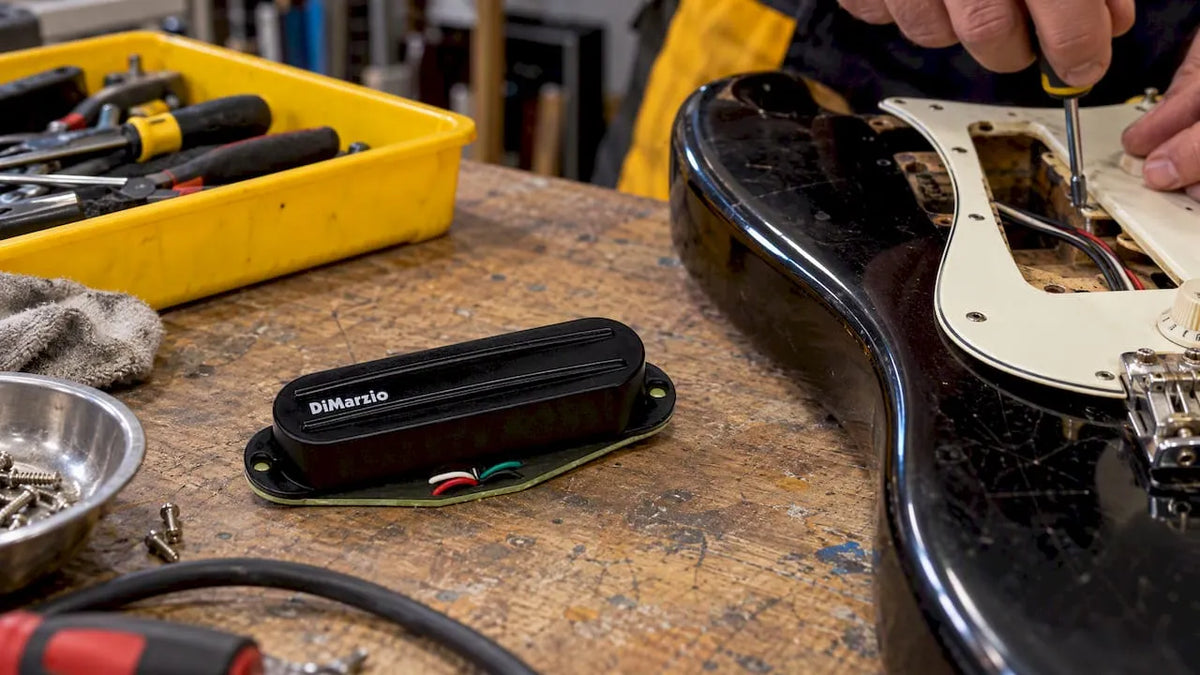
Pro Tip: The most common modification that affects value is a pickup swap. Original pickups (DiMarzio, IBZ/USA, or Bare Knuckle on higher-spec models) are worth more than aftermarket replacements, even good ones. Check whether the pickup covers match, whether the routing shows signs of enlargement, and whether the solder joints look factory-clean. A guitar with swapped pickups is not necessarily a bad buy but should be priced accordingly.
Typical price ranges and UK availability
UK pricing for Ibanez guitars follows the tier structure closely, though used prices vary considerably depending on condition, originality and the specific model’s desirability.
A few UK-specific factors are worth knowing. Prestige and J.Custom models are often imported rather than stocked as standard UK retail inventory, which means lead times can be longer and prices occasionally reflect import costs. Discontinued models such as the original RG550 and early JEM variants are primarily available through used channels, and UK demand for these is strong enough that clean examples sell quickly. For a broader view of what quality electric guitars cost in the UK across brands, Musicstreet’s UK price guide gives useful context.
When buying used in the UK, the three things most worth checking are: whether the neck is straight (a simple visual inspection with the guitar at eye level), whether the frets show significant wear, and whether the original hardware is intact. A professional setup costs roughly £40–£80 at most UK guitar shops and is almost always worthwhile on a used purchase. The CruzTools Groovetech Guitar Player Tech Kit covers the basic adjustments you can handle yourself between professional setups, and the Groovetech Mini Multi-Tool is a compact option for quick truss rod and saddle tweaks on the road.
Pro Tip: For used Prestige models, always verify the serial confirms Japanese manufacture before agreeing to a price. A Standard-tier Indonesian guitar with a Prestige-style finish can look identical in photos to a genuine Prestige. The serial prefix is the only reliable check short of an in-person inspection.
How Ibanez model lines evolved by decade
- Late 1970s–1980s: The Roadstar (RS) series established Ibanez as a serious electric guitar brand. The 1987 launch of the RG550 and JEM777 marked the shift to the modern Ibanez identity, with the Wizard neck and Edge tremolo becoming the brand’s signature traits.
- 1990s: The Prestige designation was formalised, and the SR bass series expanded significantly. The S series gained traction as a lighter alternative to the RG. The Artcore hollow and semi-hollow range launched in 1997, opening the jazz and blues market.
- 2000s: The Premium tier was introduced as a bridge between Standard and Prestige. The RGA arched-top sub-series arrived around 2005. Seven-string models became more widely available across tiers, reflecting growing demand from progressive and metal players.
- 2010s: Extended-range guitars (eight-string, nine-string) entered the catalogue. The Iron Label sub-brand launched in 2013, targeting high-gain players who wanted stripped-back spec. The RGD extended-scale series expanded to cover 26.5" and 27" configurations.
- 2019–present: The AZ series launched as a new flagship platform with a more versatile tonal character. Indonesian Premium production quality continued to improve, narrowing the gap with Japanese Prestige models for many players.
Factory shifts and what they mean for buyers: FujiGen in Japan produced the majority of high-end Ibanez guitars from the 1970s through the 2000s. Sugi (also Japan) handles some current Prestige production. Cort in Korea (serial prefix C) produced many Standard-tier models from the late 1980s through the 2000s. Indonesian factories (prefix I) now handle GIO, Standard and Premium production. The shift from Korean to Indonesian manufacture for mid-tier models happened gradually through the 2000s, and current Indonesian Premium guitars are generally considered a step up from Korean Standard models of the same era. For a broader historical overview, the Ibanez Wikipedia page covers the brand’s full production history.
First commercial extended-range milestones: The Universe UV7 (1990) was Ibanez’s first production seven-string. The RG8 (eight-string) followed in 2009, and nine-string models appeared in the early 2010s, making Ibanez one of the earliest major brands to offer extended-range guitars at accessible price points.
Musicstreet’s perspective on buying Ibanez in the UK
At Musicstreet, the questions we hear most often from UK buyers come down to three things: is it set up properly, is it what it claims to be, and is the price fair for the tier. Those are exactly the right questions. The Ibanez range is broad enough that a buyer who doesn’t understand the tier system can easily pay Prestige money for a Premium guitar, or dismiss a genuinely excellent Indonesian Premium because they assumed it would be inferior to an older Japanese model. The serial number check takes thirty seconds and removes most of the uncertainty. For anything above the Standard tier, an in-person inspection before buying used is worth the effort, particularly for tremolo-equipped models where the condition of the knife edges and the spring claw matters as much as the body and neck. We inspect every pre-owned instrument that comes through our Huntingdon store before it goes on sale, and we’re happy to answer identification questions for buyers who want a second opinion before committing.
Musicstreet stocks new and pre-owned Ibanez guitars across the UK
Musicstreet carries both new and pre-owned Ibanez guitars, from entry-level GIO models through to higher-tier electrics and basses, with every used instrument inspected and set up before sale. If you’re after a used Ibanez bass to start with, the used Ibanez GSR200 is a well-regarded entry point from the Soundgear family. For a used entry-level electric, the used Ibanez GSA60 in walnut is a clean example of what GIO delivers at a sensible price.
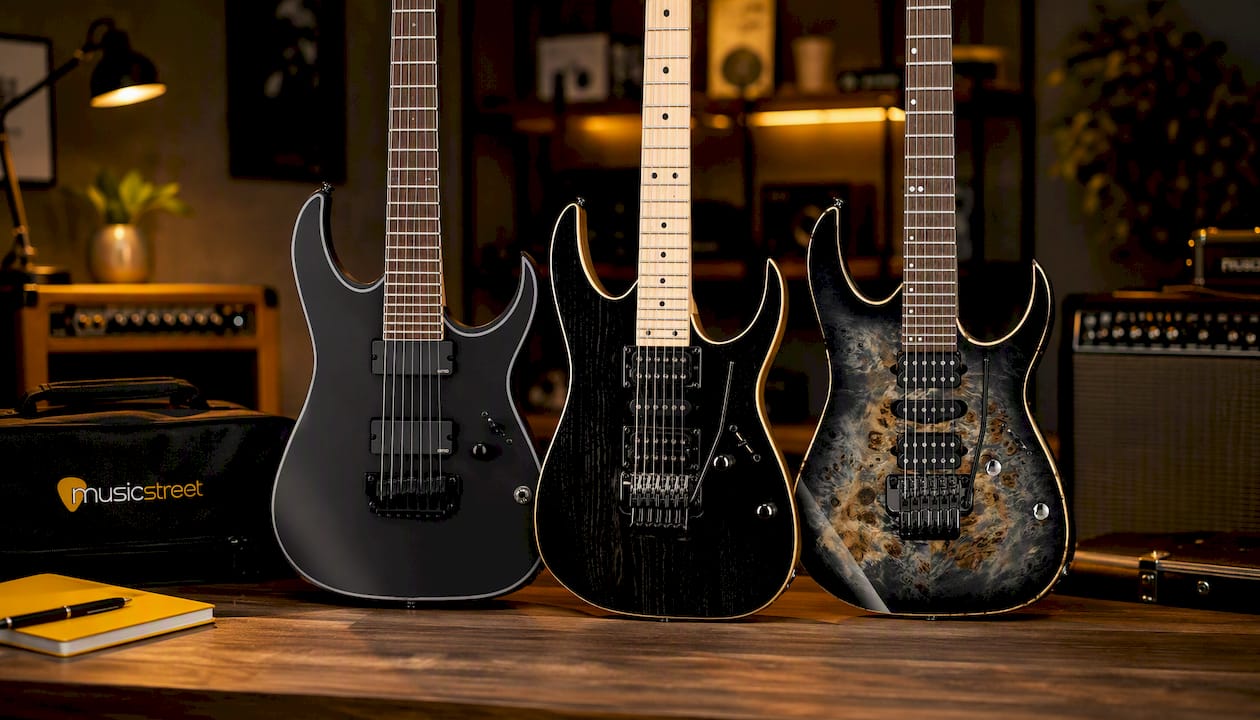
Every purchase comes with free UK delivery on qualifying orders, an insurance-supported warranty, and access to Musicstreet’s setup and repair service at the Huntingdon store. If you want to try before you buy, the store is open for in-person visits where you can play instruments and get expert advice on identification, spec checks and setup options. Browse the full range or get in touch with the team directly at Musicstreet.
Sources
- Ibanez RG — Wikipedia
- Ibanez Serial Number Lookup - Date Your Guitar | Guitar Serial Lookup
- The Guitar Dater Project - Ibanez serial number decoder
- Best Ibanez Guitars Ranked — RG, AZ, Artcore, S Series (2026) | ToneStakr
- Ibanez model numbers - Ibanez Wiki - Fandom
FAQ
What are the main Ibanez guitar series?
The main electric series are the RG, S, AZ, JEM, JS, SA and Artcore (AS/AF). The SR is the primary bass series. Each series has multiple sub-variants and spans several quality tiers from GIO through to J.Custom.
How do I identify my Ibanez model?
Check the serial number on the back of the headstock and the model code on the headstock front. Run the serial through the Guitar Dater Project decoder to confirm the factory and production year, then cross-reference the spec against the Ibanez Wiki model list.
What are the most popular Ibanez guitar models?
The RG550, JEM777, JS1000, AS73 and SR800 are among the most consistently recommended and traded Ibanez models. The RG550 in particular is widely regarded as the guitar that defined the modern Ibanez identity when it launched in 1987.
What is my Ibanez guitar worth?
Value depends on tier, condition, originality and specific model. As a rough guide, used GIO models sell for £80–£200, Standard for £180–£450, Premium for £400–£750, and Prestige for £700–£1,600 in the UK market. Modifications such as pickup swaps or refinishes typically reduce value relative to an all-original example.






Share:
Overdrive for guitarists: what it is and how to use it
Electric guitar equipment list for beginners: essentials