

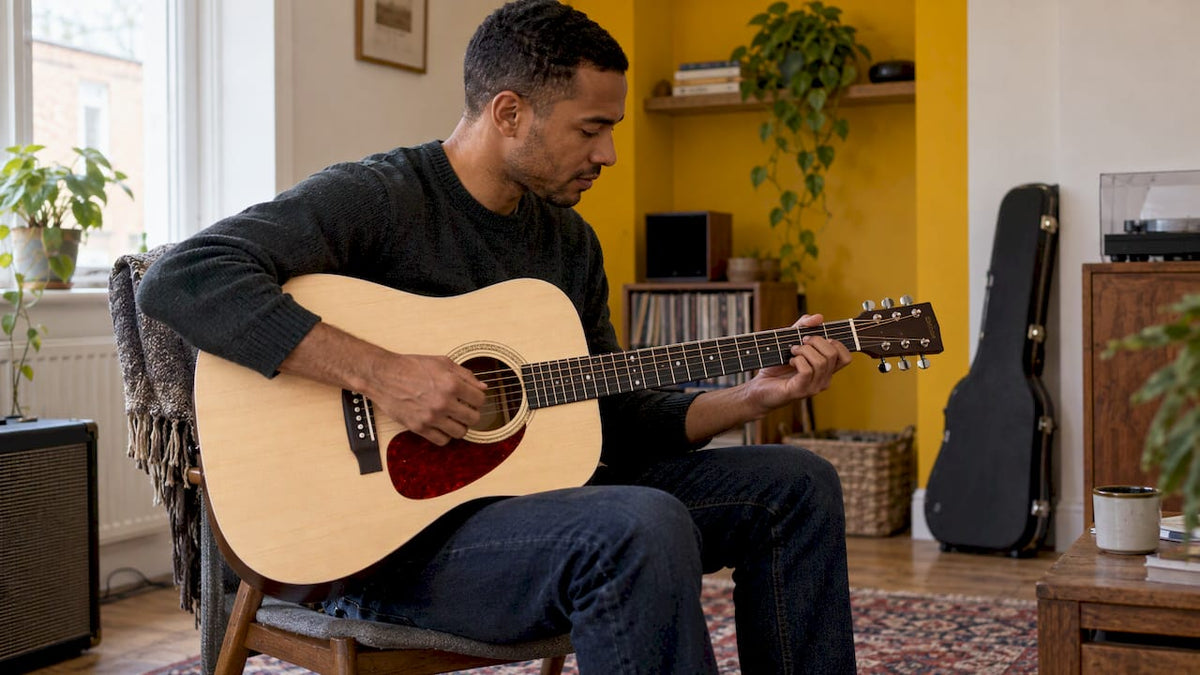
Acoustic guitars come in roughly four size bands: small (travel, junior and parlour), medium (concert and grand auditorium), large (dreadnought) and extra large (jumbo). Within them sit fractional sizes such as 1/2 and 3/4 for children and travel. Size changes how the guitar sounds, how it sits on your body and how far you can comfortably stretch along the neck. This guide sets out each size in plain terms, with typical measurements, so you can narrow the choice before you pick one up in the shop. At MusicStreet in Huntingdon you can try different sizes side by side, which is the quickest way to confirm what the numbers suggest.
Table of Contents
- Size, shape and scale length: three things that get mixed up
- The main acoustic guitar sizes, smallest to largest
- What about 1/2 and 3/4 acoustic guitars?
- Scale length: the measurement that decides comfort
- How size changes sound, comfort and portability
- Which acoustic guitar size suits you?
- Try the sizes at MusicStreet
- Our view on choosing size
- FAQ
- Sources
Size, shape and scale length: three things that get mixed up
Most shop listings use “size” and “shape” as if they were the same thing. They are related but different, and knowing the difference makes every spec sheet easier to read.
- Body size is how big the box is: length, width across the widest part (the lower bout) and depth.
- Body shape is the outline: the curve of the shoulders, the waist and the bouts. A dreadnought and a jumbo can both be “large” but have quite different outlines.
- Scale length is the vibrating length of the string, from nut to bridge saddle. It decides how far apart the frets are and how tight the strings feel.
The body works like the guitar’s speaker. String vibration passes through the bridge into the top, back and sides, so even a small change in body shape, size or material alters the sound. That is why makers produce so many subtly different bodies, and why two guitars of the same “size” can still feel different.
If scale length is new to you, our plain guide to scale length on a guitar explains it in more detail.
The main acoustic guitar sizes, smallest to largest
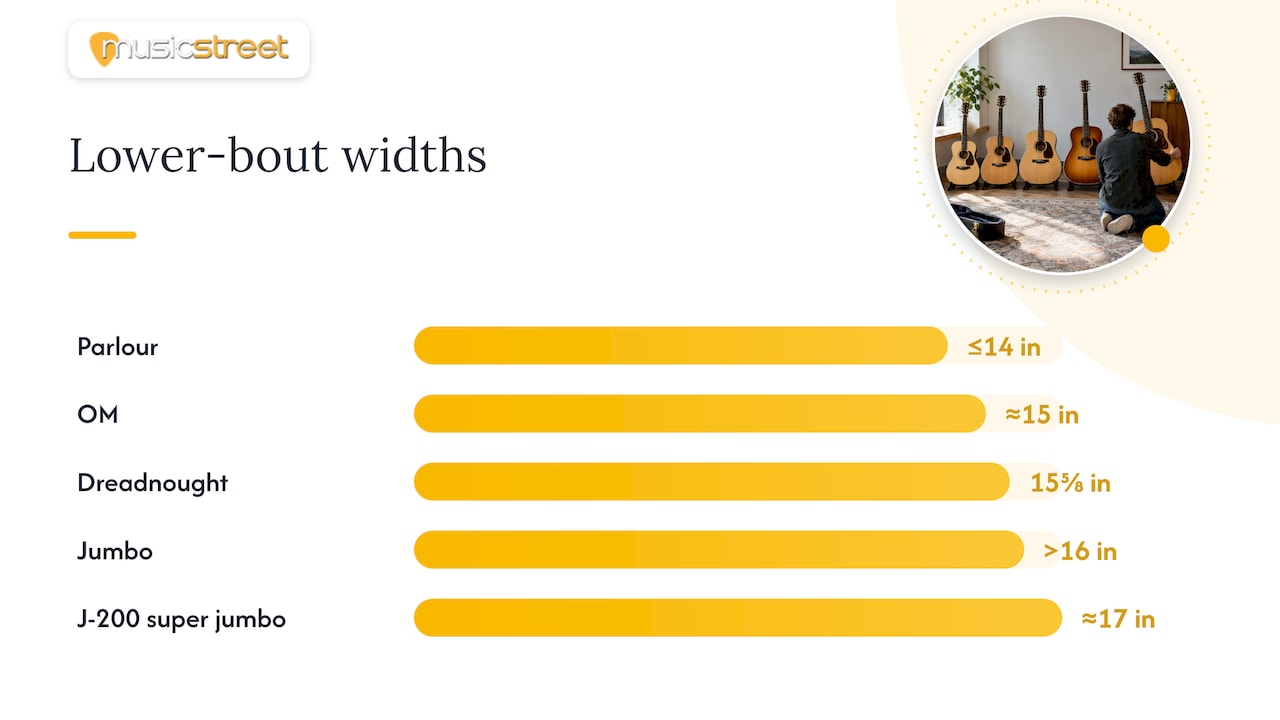
Manufacturers do not agree on exact dimensions, so treat every figure below as typical, not fixed. The widths are lower-bout measurements, the broadest part of the body, taken from Fender’s body-shape guide and Acoustic Guitar magazine’s identification guide.
| Size | Typical lower bout | Typical character | Often suits |
|---|---|---|---|
| Parlour | about 13 to 13¼ in (33 to 34 cm) | Focused, mid-rich, intimate | Fingerstyle, songwriting, small hands, couch playing |
| Concert (0) | about 13½ in (34 cm) | Balanced, slightly sweet | Fingerstyle and light strumming |
| Grand concert (00) | about 14 in (36 cm) | Balanced, clear | All-round playing |
| Auditorium (000 / OM) | about 15 in (38 cm) | Even, full-range | Versatile: strumming and picking |
| Dreadnought | about 15⅝ in (40 cm) | Full, strong low end, dynamic | Strumming, vocal accompaniment, bands |
| Jumbo | over 16 in (41 cm) | Big, warm, powerful | Strummers who need to fill a room |
The names overlap in practice. A grand auditorium, for instance, is described by some makers at around 16 in and by others nearer 15 in, so always check the maker’s own dimensions rather than relying on the label alone.
Small bodies: parlour, travel and junior
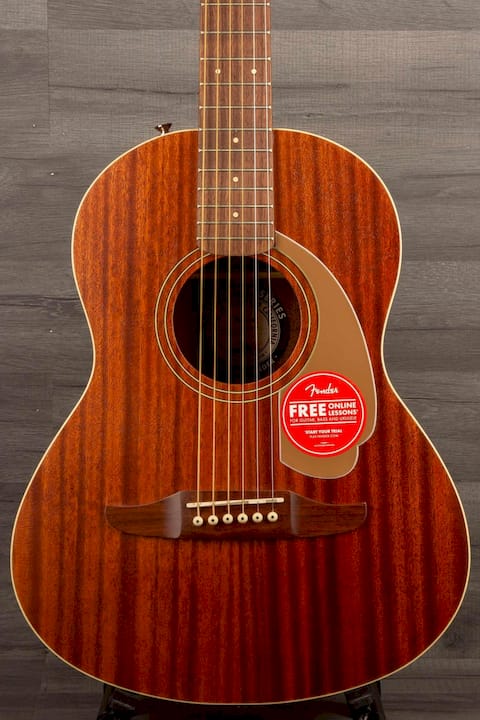
Parlour guitars are built around a lower bout of roughly 355 mm (14 in) or less and a body about 100 to 105 mm (4 in) deep, according to MusicRadar’s body-shape guide. Tonally they lean towards the middle and upper frequencies, which is why American Songwriter points them towards fingerstyle players and singer-songwriters.
Travel and junior guitars go smaller still. Yamaha groups travel and junior models with parlours in its small category, and notes that a shorter scale means lower string tension. For a small player or a returning adult who wants an easy-feeling guitar, that lower tension is the real benefit.
Medium bodies: concert and grand auditorium
This band is where many players end up. Concert, grand concert and auditorium (often marked 000 or OM) guitars are narrower and shallower than a dreadnought. The OM has a lower bout of about 15 in and a body depth that tapers from about 4⅛ in at the endpin to 3¼ in at the neck, based on Acoustic Guitar magazine’s figures for Martin’s shapes. They are usually described as balanced, with a clear midrange and enough bass to sound complete without being boomy.
Large bodies: the dreadnought
The dreadnought is the shape most people picture when they think “acoustic guitar”. Martin’s 14-fret dreadnought measures about 15⅝ in across the lower bout, with depth tapering from 4⅞ in down to 3⅞ in. MusicRadar gives a typical scale length of around 645 mm (25.4 in). American Songwriter calls it the most common size, with a full and dynamic sound, which makes it a sensible default for strumming and singing.
Extra large: the jumbo
Jumbos have the widest bodies, with lower bouts above 16 in. MusicRadar notes that Gibson’s J-185 small jumbo measures about 16 in across and the J-200 super jumbo about 17 in. They suit strummers who need to fill a space, though American Songwriter points out the large lower bout can feel awkward on some body frames. Sit with one before you decide.
What about 1/2 and 3/4 acoustic guitars?
Fractional sizes exist mainly for children and for travel. They tune exactly like a full-size guitar, to EADGBE, so what you learn transfers directly.
The fractions are loose labels, not exact proportions. Ortega’s acoustic range gives a useful guide to scale lengths:
| Label | Approximate scale length | Typical player |
|---|---|---|
| Full size (4/4) | about 25 in (650 mm) | Adults and teenagers |
| 7/8 | about 24 in (615 mm) | Teenagers and smaller hands |
| 3/4 | about 23 in (590 mm) | Younger students |
| 1/2 | about 22 in (560 mm) | Children and travel |
| 1/4 | about 17 in (438 mm) | Young children and travel |
Another maker’s 3/4 guitar can differ by an inch or more, so the exact scale length is more informative than the fraction. As a rough guide, children aged about 8 to 12 often start on a 3/4, and some petite adults choose one for comfort. A teenager with smaller hands may find a 7/8 size a good halfway house.
Scale length: the measurement that decides comfort
Total guitar length is a poor guide to whether an instrument is full size, because makers design bodies, headstocks and necks in different proportions. A full-size acoustic has a scale length of around 25 in (about 635 to 650 mm). A guitar in that region is full size even if its overall length differs from another model’s. Much shorter than that and it is a scaled-down instrument.
Short scale matters beyond children. A shorter scale means the frets sit closer together and the strings are slacker at standard pitch. Yamaha’s UK team notes that a slightly shorter neck feels more comfortable and gives a brighter, clearer tone. If you have smaller hands, reduced stretch or sore fingers while learning, a short-scale full-body guitar can be more useful than a smaller body.
That is also why MusicRadar quotes two different scale lengths for similar shapes: the OM sits at about 645 mm (25.4 in) while the 000 is shorter at about 632 mm (24.9 in). Two guitars labelled “000” and “OM” are therefore not interchangeable under the fingers.
How size changes sound, comfort and portability
Sound
As a general rule, a bigger body gives a bigger sound with more bass and treble response, while a smaller body offers a stronger midrange. Yamaha adds that jumbos offer projection, low-end response and warm tones that sit well under a voice.
Proportions matter as much as size, though. Gibson explains that a jumbo’s narrow waist keeps the low end from getting too boomy, so a bigger body does not automatically mean more bass. Depth also plays a part: Fender notes that deeper bodies add resonance and bass, while shallower bodies project with better balance.
Comfort
Comfort is about three contact points: how your picking arm reaches over the lower bout, how the upper bout rests against your chest, and how your fretting hand reaches along the neck. A wide jumbo can push a smaller player’s picking arm uncomfortably high. A parlour sits low and close, which many players find relaxing for long sessions. Depth matters too, since a deep body can feel bulky against the ribs.
Portability
A parlour or travel guitar fits easily into a gig bag and a small car boot or train luggage rack. A jumbo needs a properly fitted case. Whatever you choose, a case or gig bag sized to the instrument protects it, particularly if you travel on public transport.
Which acoustic guitar size suits you?
There is no single correct size. Match the guitar to your body, your hands and the way you play.
- Start with your hands and frame. If a full-size guitar feels like a stretch, look at short-scale models, a parlour or a 7/8 or 3/4 size.
- Think about what you play. Fingerstyle and quiet songwriting suit parlour and concert sizes. Strumming with a singer suits a dreadnought. Heavy strumming in a band or on a stage can suit a jumbo.
- Consider where you play. Mostly at home or on the sofa? Smaller bodies are easy to live with. Regular rehearsals or open mics? A bigger body gives you more projection.
- Consider your age and growth. Children should be fitted for their current size, not the size they will grow into, because a guitar that is too big makes learning harder.
- Try before you buy. Sit down, play standing and sitting, and see how your arm falls over the body.
For a beginner who is unsure, a parlour or 000-size guitar often fits better than a full dreadnought, and our guide to three acoustic sizes sets out shop tests to find your best fit. If you are still deciding between acoustic and electric, our beginner comparison of acoustic and electric guitars covers playability and learning.
Try the sizes at MusicStreet
We sell new and pre-owned acoustic guitars online and from our shop in Huntingdon, Cambridgeshire, with in-store tryouts so you can feel the difference between sizes in your own hands. Every instrument is inspected and set up by experts, and we offer post-sale support and insurance-backed warranties.
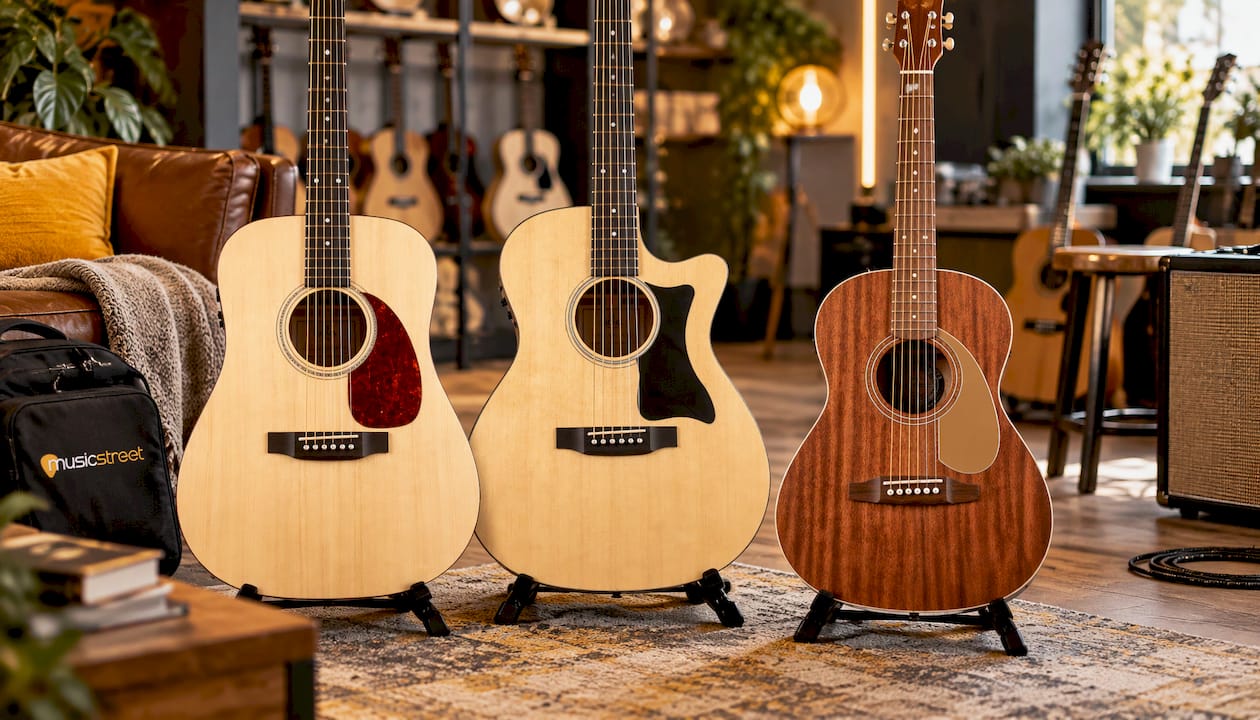
If you want a full-body feel with a shorter reach, look at the Sigma DSME shortscale dreadnought shape 14 fret. If you want something compact for travel or a younger player, see the Fender Sonoran Mini. The whole range is in our acoustic guitars collection, and a setup can make any size noticeably easier to play.
Our view on choosing size
Most people choose an acoustic guitar by name or by the look of it, then wonder why it never feels quite right. In our experience, fit comes first. A guitar you want to pick up every evening will teach you more than a bigger, louder one that stays in its case.
Today’s sizes grew out of a need for volume, as makers built broader, deeper guitars for clubs and bars. Amplification has since removed that constraint, so each size now offers something different, and that is why many guitarists end up owning more than one.
That is why we put so much weight on inspection, setup and in-store tryouts. Size on paper only tells you part of the story: the action, the neck feel and how the body sits against you finish it. A properly set-up smaller guitar often plays better than a neglected larger one, and we stand behind each instrument with after-sale support.
Music
FAQ
What is the standard size of an acoustic guitar?
There is no single standard, but the dreadnought is the most common full-size body, with a scale length of around 645 mm (25.4 in). Full-size guitars are made for adults and teenagers, and span several body sizes from concert up to jumbo.
Is a 38-inch acoustic guitar full size?
Usually yes. Total length varies with the design, so scale length is the better test: around 25 in (about 635 to 650 mm) or more points to a full-size guitar. A jumbo and a smaller-bodied guitar can both be full size yet feel very different in bulk.
What size acoustic guitar is best for a beginner?
It depends on your frame and hands. Many adult beginners are comfortable on a dreadnought, but a parlour or 000-size guitar is often easier to hold, and a short-scale model can make fretting gentler. Children usually do best on a 1/2 or 3/4 size, depending on their height and age.
Is a 3/4 guitar three-quarters the size of a full-size guitar?
Not exactly. Fractions are loose labels, and scale lengths for a 3/4 vary between makers: Ortega, for example, lists about 23 in (590 mm) against about 25 in (650 mm) for full size. A 3/4 guitar tunes the same as a full-size one, so lessons and chord shapes carry over.
Sources
- Acoustic guitar anatomy, Yamaha UK and Ireland
- Different acoustic guitar body shapes, Fender
- A guide to identifying common acoustic guitar shapes and sizes, Acoustic Guitar
- From parlour to jumbo: acoustic guitar body shapes, MusicRadar
- How to find the perfect acoustic guitar, American Songwriter
- What are the different acoustic guitar body types?, Yamaha
- Acoustic guitars, Ortega Guitars
- Acoustic guitar body types, Gibson


Share:
What Do Direct Boxes Do? A Guitarist's Guide to DI Boxes