


The Fender Stratocaster is a legendary electric guitar model introduced in 1954, known for its innovative design and iconic sound. Its name, coined by Don Randall, likely evokes aspirations related to the sky or aviation progress, reflecting the era’s fascination with space and flight. As a protected brand, “Stratocaster” signifies a specific instrument with unique features that distinguish it from similar guitars, shaping its enduring influence across musical genres.
The Stratocaster is defined as Fender’s iconic double-cutaway electric guitar model, first produced in 1954 and widely regarded as the most influential solid-body electric guitar ever made. The name itself is a constructed word, not a dictionary term, and its precise origin remains genuinely disputed. What is not disputed is its significance: the Fender Stratocaster reshaped how electric guitars were designed, played, and heard across virtually every genre of popular music. If you have ever wondered what does Stratocaster mean beyond the name on the headstock, the answer spans etymology, engineering, trademark law, and cultural history.
What is the origin of the name “Stratocaster”?
The name “Stratocaster” was chosen by Don Randall, Fender’s sales and marketing director in the early 1950s. Randall had previously named the Broadcaster (later the Telecaster), so the task of naming Fender’s ambitious new model fell naturally to him. What he settled on was a compound word that felt modern, aspirational, and unmistakably American for its era.
Two competing theories explain where the name came from, and neither has been definitively confirmed:
- The stratosphere theory. The name may derive from “stratosphere,” the layer of Earth’s atmosphere above the troposphere. In the early 1950s, the stratosphere carried enormous cultural weight. Aviation was advancing rapidly, and the idea of reaching the upper atmosphere felt like the frontier of human achievement. A guitar named after the stratosphere would signal something extraordinary and forward-looking.
- The Stratocruiser theory. The name may have been inspired by the Boeing 377 Stratocruiser, a prestigious passenger aircraft of the period. The Stratocruiser was considered the height of luxury air travel in the early 1950s, and its name carried connotations of speed, modernity, and prestige. Randall may have borrowed directly from this cultural touchstone.
Both theories are plausible, and both reflect the same underlying truth about the 1950s: aviation and space were the dominant symbols of progress. Naming a guitar after something associated with the sky or the stratosphere was a deliberate act of positioning. It told players and buyers that this instrument was not just new. It was the future.
“The name ‘Stratocaster’ was not chosen arbitrarily. It was crafted to evoke aspiration at a moment when the sky itself felt like the limit.” This framing matters because it explains why the name still carries weight today, even for players who have never thought about its etymology.
What is worth noting is that Don Randall’s role in naming Fender products is well established, but he never provided a single definitive account of his precise inspiration. Content that presents one theory as fact is oversimplifying a genuinely open question.
What design features define the Stratocaster guitar?
The Stratocaster’s design features are as significant as its name. When Fender introduced the model in 1954, it represented a substantial leap beyond the Telecaster in terms of ergonomics, tonal range, and playability. The guitar was built as a package of innovations, not a single improvement.
The core physical and technical characteristics include:
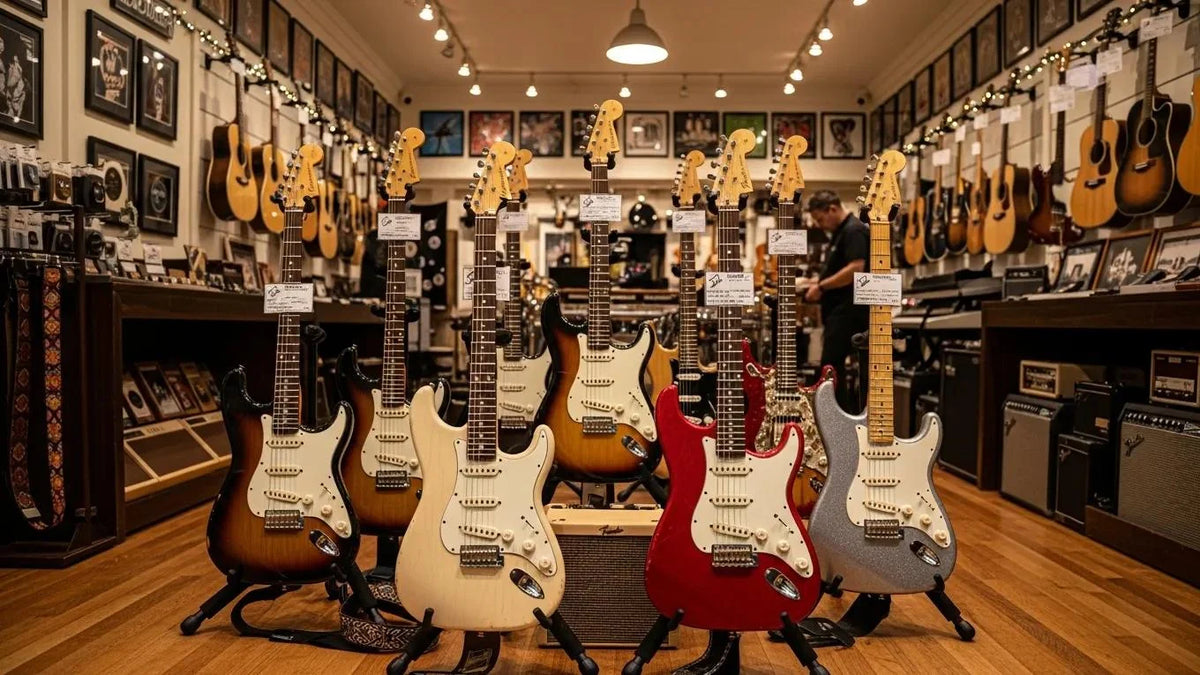
- Contoured double-cutaway body. The body was carved with a forearm contour on the front and a ribcage contour on the back, making it far more comfortable to hold for extended periods than flat-bodied predecessors.
- Body woods. Fender typically used alder or ash for the body, chosen for their tonal properties and availability. Alder produces a balanced, full-bodied tone, while ash tends toward a brighter, more pronounced attack.
- Maple neck with fingerboard options. The bolt-on maple neck was a Fender signature. Players could choose between a maple fingerboard or a rosewood fingerboard, each offering a subtly different feel and tonal character.
- Three single-coil pickups. The three-pickup configuration gave players access to a far wider tonal palette than the Telecaster’s two-pickup layout. The five-way selector switch (added in the 1970s) allowed combinations that produced the distinctive “in-between” tones now synonymous with the instrument.
- Tremolo arm bridge system. The detachable tremolo arm was a defining innovation, enabling expressive vibrato effects while maintaining tuning stability. This was genuinely new in 1954 and gave players an expressive tool that fixed-bridge guitars simply could not offer.
- Trademarked headstock shape. The distinctive inline tuner headstock is itself a protected design element, immediately recognisable and legally distinct from copies.
The double-cutaway body shape with its two “horns” also allowed easier access to higher frets compared to single-cutaway designs, a practical advantage for lead guitarists working in the upper register.
| Feature | Stratocaster specification |
|---|---|
| Body shape | Double-cutaway, contoured |
| Typical body wood | Alder or ash |
| Neck construction | Bolt-on maple |
| Pickups | Three single-coil |
| Bridge | Tremolo with detachable arm |
| Fingerboard options | Maple or rosewood |
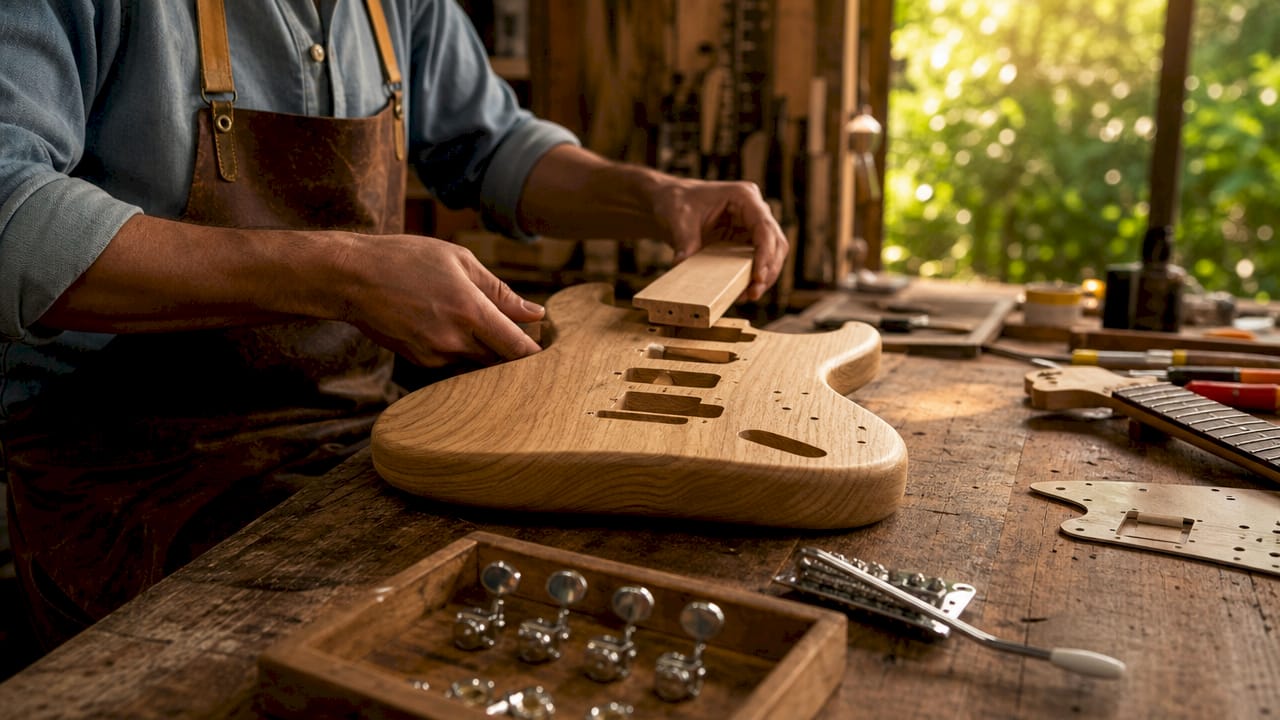
Pro Tip: If you are trying a Stratocaster for the first time, pay attention to the body contouring. The forearm and ribcage bevels are subtle but make a real difference over a long playing session. A flat-bodied guitar of similar weight will feel noticeably less comfortable within an hour.
How does the Stratocaster compare to the Telecaster and other Fender guitars?
The Stratocaster vs Telecaster question is one of the most common in guitar buying, and the differences go well beyond aesthetics. Both are Fender instruments with bolt-on maple necks and single-coil pickups, but they are built for different playing experiences.
| Feature | Stratocaster | Telecaster |
|---|---|---|
| Body shape | Double-cutaway, contoured | Single-cutaway, flat slab |
| Pickups | Three single-coil | Two single-coil |
| Bridge | Tremolo arm available | Fixed bridge (typically) |
| Tonal range | Broader, with in-between positions | Brighter, more direct |
| Playing comfort | Higher, due to body contouring | Slightly less ergonomic |
| Genre association | Rock, blues, funk, pop | Country, rock, indie |
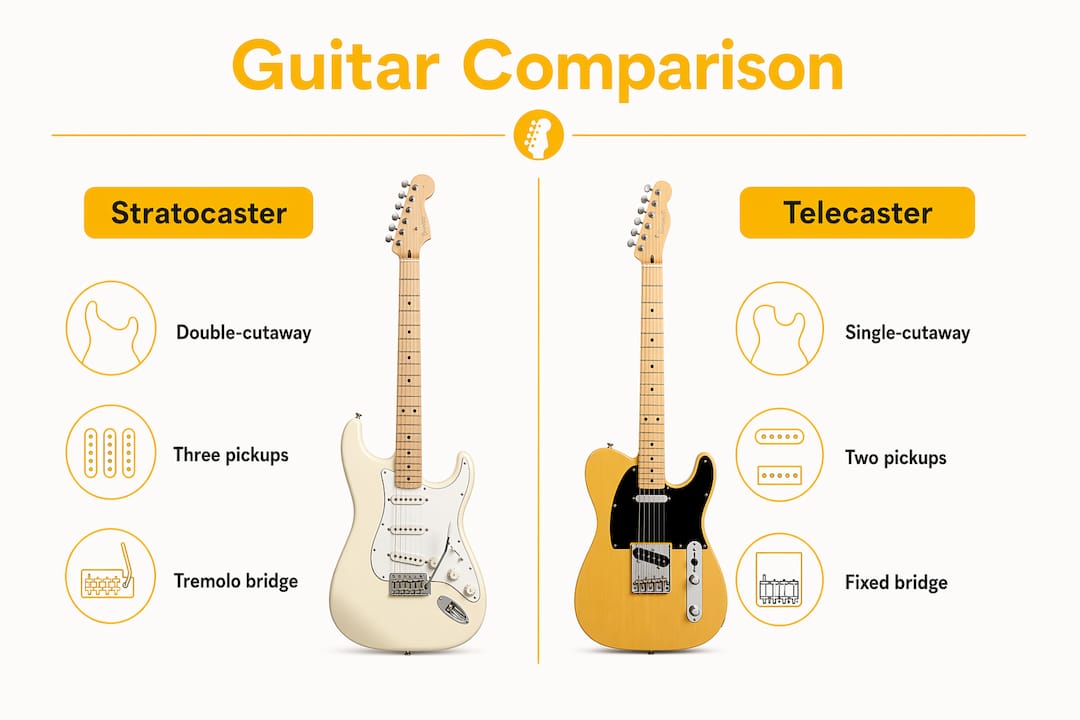
The Telecaster arrived first, in 1950, and its simplicity is a genuine virtue. It has a direct, punchy tone that suits country picking and rhythm playing exceptionally well. The Stratocaster was designed to offer more: more tonal options, more playing comfort, and more expressive capability through the tremolo system.
The ergonomic advances of the Stratocaster influenced virtually every solid-body electric guitar designed after 1954. Body contouring, multi-pickup switching, and vibrato systems all became standard features across the industry because Fender proved they worked.
One common misconception is worth addressing directly. Many players and sellers use the term “Strat-style” to describe any double-cutaway guitar with three single-coil pickups. This is not the same as a Stratocaster. The term “Stratocaster” refers specifically to a genuine Fender product. “Strat-style” is the industry’s way of describing similar guitars from other manufacturers without infringing on Fender’s trademark.
Why does the Stratocaster name carry trademark significance?
The Stratocaster definition is not just a description of a guitar shape. It is a legally protected brand identifier. Fender holds trademarks on both “STRATOCASTER” and “STRAT” in the UK, with protections in place since the 1970s. These trademarks prevent any other manufacturer from using those exact terms to describe or market their instruments.
This matters practically for anyone buying a guitar. A guitar described as a “Stratocaster” must be a genuine Fender product. A guitar described as “Strat-style,” “S-type,” or “ST-style” is a similar design from a different manufacturer. The trademark protections also extend to trade dress, meaning the distinctive headstock shape and certain design elements are protected beyond just the name itself.
The Stratocaster name functions as both a product name and a brand identifier, not a generic descriptor for a category of guitars. This is a distinction that matters enormously in the second-hand market, where listings sometimes blur the line between genuine Fender instruments and similar-looking alternatives.
Pro Tip: When buying a used guitar described as a “Stratocaster,” always verify the headstock logo and serial number. Genuine Fender Stratocasters carry specific serial number formats that correspond to their year and country of manufacture. A quick check against Fender’s official records takes two minutes and removes all doubt.
Key takeaways
The Stratocaster is a legally protected Fender product name, not a generic guitar category, and its meaning spans etymology, design innovation, and trademark law.
| Point | Details |
|---|---|
| Stratocaster definition | A specific Fender electric guitar model produced since 1954, not a generic guitar type. |
| Name origin | Coined by Don Randall, likely inspired by the stratosphere or the Boeing 377 Stratocruiser. |
| Defining design features | Three single-coil pickups, contoured double-cutaway body, and a tremolo arm bridge system. |
| Trademark protection | Fender holds UK trademarks on “Stratocaster” and “Strat,” restricting use to genuine Fender products. |
| Stratocaster vs Telecaster | The Stratocaster offers greater tonal range and playing comfort; the Telecaster is simpler and more direct. |
Why the Stratocaster still earns its reputation
I have handled a great many guitars over the years, and the Stratocaster remains the instrument that consistently surprises people who come to it with low expectations. Players who have spent time with cheaper “Strat-style” copies often assume they already know what a Stratocaster feels like. They do not. The body contouring alone changes the experience in a way that is genuinely difficult to describe until you feel it for yourself.
What strikes me most about the Stratocaster’s legacy is how little it has needed to change. The core design from 1954 is still the core design today. Fender has refined manufacturing tolerances, updated pickup specifications, and expanded the range of available models, but the fundamental architecture has remained intact for over 70 years. That is not nostalgia. That is evidence of a design that was correct from the start.
The misconception I encounter most often is the belief that “Stratocaster” is simply a shape. It is not. It is a specific instrument with specific characteristics, built to specific standards, and protected by specific legal rights. Understanding that distinction changes how you shop, how you talk about guitars, and how you evaluate what you are actually holding. If you are considering buying a Fender Stratocaster, take the time to understand what makes the genuine article different from the many instruments that borrow its silhouette.
Find your Stratocaster at Musicstreet
Musicstreet stocks a carefully selected range of genuine Fender Stratocaster models, from entry-level Player Series instruments to professional-grade American setups. Every guitar is professionally inspected before sale, and the team in Huntingdon, Cambridgeshire is available to help you find the right model for your playing style and budget.

Whether you are buying your first electric guitar or adding a specific Stratocaster variant to an existing collection, Musicstreet offers expert guidance alongside its full catalogue. Visit Musicstreet to browse current stock, explore iconic Fender models and their histories, or get in touch directly for personalised advice. Free UK delivery is available on qualifying orders.
FAQ
What does Stratocaster mean exactly?
Stratocaster is the name of Fender’s iconic electric guitar model, first produced in 1954. It is a constructed brand name, not a dictionary word, and refers specifically to a Fender product rather than a generic guitar type.
Who came up with the name Stratocaster?
The name was coined by Don Randall, Fender’s sales director in the early 1950s. The precise inspiration is debated, with theories pointing to either the stratosphere or the Boeing 377 Stratocruiser aircraft.
Is “Strat” the same as “Stratocaster”?
“Strat” is a widely used shorthand for Stratocaster and is itself a protected Fender trademark in the UK. Guitars from other manufacturers cannot legally be called a “Strat” and instead use terms like “Strat-style” or “S-type.”
How is the Stratocaster different from the Telecaster?
The Stratocaster features a contoured double-cutaway body, three pickups, and a tremolo arm bridge, while the Telecaster has a flat single-cutaway body, two pickups, and typically a fixed bridge. The Stratocaster offers broader tonal options and greater playing comfort.
When was the Fender Stratocaster first made?
The Fender Stratocaster was first produced in 1954, making it one of the longest-running and most continuously produced electric guitar models in history.







Share:
How to select a guitar for beginners: your first guide
How to replace guitar strings: a step-by-step guide